Botanical name: Plantago lanceolata
Family name: Plantaginaceae
Overview
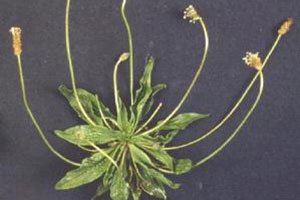
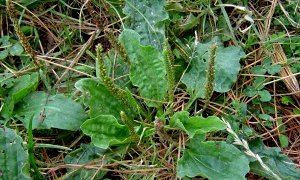
Narrow-leaved plantain.
Narrow-leaved plantain is a very common perennial weed found in many lawns and pastures, and often in waste places as well. It is typically found in "run-down" pastures which do not have much grass and clover in them. It doesn't cause any harm, and is actually eaten by livestock and therefore is quite useful. However, pastures with more narrow-leaved plantain than grass in the past have usually been low-producing pastures, and so was often a sign that the pasture needed replacing, though as discussed below, this is changing.
The plantains are often lumped in with dandelion and weeds similar to this species are all called "flat weeds". As with all these species, it tolerates low fertility conditions well. However, a weed is a plant growing where it’s not wanted, interfering with human activities.
The tolerance that narrow-leaved plantain has of low fertility plus its palatability to livestock has resulted in release of a number of cultivars of narrow-leaved plantain (such as Agritonic) for inclusion into pasture mixes, initially for organic farming systems where species may need to tolerate low fertiliser inputs, but now also for high levels of animal production and also for its role in reducing nitrate leaching from animals grazing on it. These improved cultivars are often simply called plantain.
Our research has shown it has higher concentrations of certain minerals such as copper and zinc than ryegrass or clover. Therefore there can be some debate over whether this is really a weed in pastures at all, though the improved cultivars are much more productive than the fairly low-producing weedy type, so the unimproved plants are often considered as weeds in the improved plantain pastures. Certainly in lawns though, it has no useful features and generally creates an eye sore.
Distinguishing features
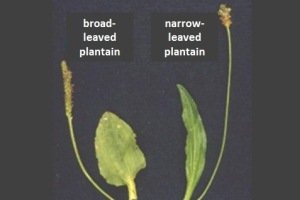
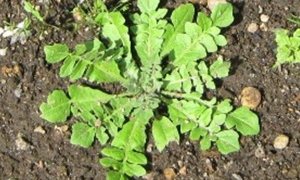
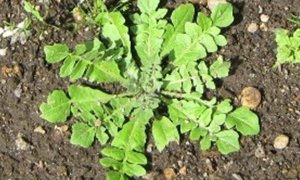
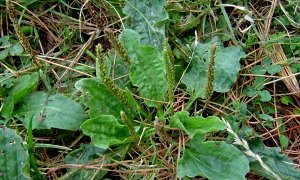
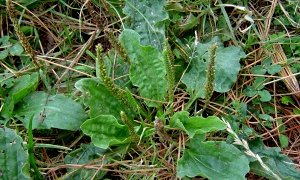
Leaf comparison between the broad-leaved plantain and the narrow-leaved plantain.
The only weed that narrow-leaved plantain is likely to be confused with is broad-leaved plantain. However, the leaf shape and width are quite different. Also, the brownish fruits on the seed head of narrow-leaved plantain are clustered closer to the tip of the stem than with broad-leaved plantain where fruits extend much further down the stem.
The plantains tend not to have a standard tap root like the other flat weeds. There is a definite crown just below ground level. However, there is usually a large number of adventitious roots spreading downward from this crown rather than a single tap root.
With narrow-leaved plantain, a short thick rhizome also often forms from which new plants can develop. The wild form of narrow-leaved plantain can usually be distinguished from the improved cultivars such as Agritonic as the latter tend to have more erect leaves and grow more vigorously than the prostrate wild type.
Control
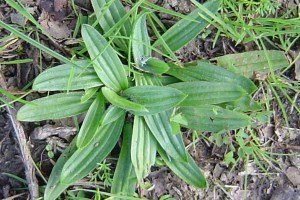
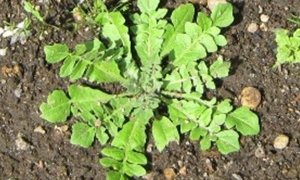
Narrow-leaved plantain leaves.
Plantains are susceptible to many hormone herbicides such as 2,4-D, mecoprop and MCPA, making them easy to remove selectively from turf. Dicamba used by itself tends not to be very effective, and clopyralid (Versatill) needs to be applied at higher rates to get good control. Aminopyralid (T-Max) is also poor on it, but this makes it a useful herbicide for spot-spraying thistles in pastures in which the improved cultivars of narrow-leaved plantain have been planted. Flumetsulam (Preside) has little effect on established narrow-leaved plantain either, so is often used to control certain weed species in pastures with a clover/plantain sward.
Note though that in research we undertook in 2011 on herbicides to use in new plantain/clover/chicory mixes we found flumetsulam can give plantain seedlings quite a check in growth initially. In other research we conducted more recently, results suggest the best way to control weeds in establishing ryegrass/clover/plantain swards is to apply a combination of bentazone and half the recommended rate of a commercial MCPB/MCPA mix, followed by mowing a few weeks later. In established swards, after grazing the pasture below the height of a wiper, applying aminopyralid or a 1:20 mix of a Glyphosate 360 product with water using a weed wiper to tall weeds left ungrazed should be safe for the pasture even if plantain seedheads have not been grazed.
In pastures, if you did want to kill narrow-leaved plantain then MCPA could be used to control it, but if you are spraying just to get rid of narrow-leaved plantain, you need to ask yourself why you are doing this. In waste areas, narrow-leaved plantain shows some tolerance to low rates of glyphosate. In orchards, it is resistant to diuron.
Similar species
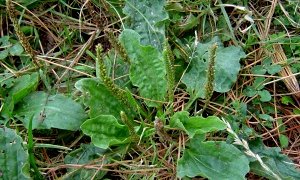

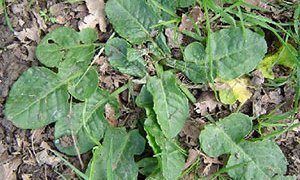
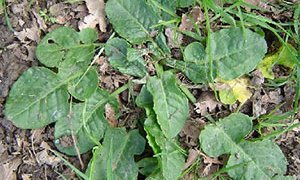
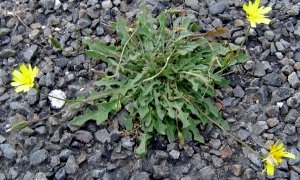
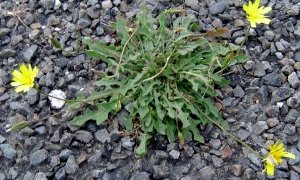
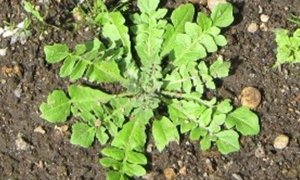
Shepherd's purse
Shepherd's purse starts as a rosette and then grows an upright flower stem with heart-shaped seed pods.