A wee while ago now, maybe about a month, I was approached by a slightly weathered-looking guy while I was packing groceries into my car outside our local supermarket. He asked if I had any spare change and I said something along the lines of, "Sorry mate, I don’t."
Like many of us in Aotearoa, I have these sorts of interactions all the time now. The next thing he said really struck me.
He said, "Don’t be sorry mate, I’m sorry, I hate having to ask."
What got me even more than his words was that I recognised something very familiar in the guy, a bit of myself. He looked about my age, similar lines in similar parts of our faces. We both had Puma trainers on. Just one middle-aged guy asking another for help.
After he walked off, I went back into the supermarket and got some cash from the ATM. I returned to the carpark but couldn’t find him anywhere. The money is still in my wallet, it’s his the next time he asks.
We all need a little help sometimes.
Under the proposed Summary Offences (Move-on Orders) Amendment Bill, this man’s appeal for my help constitutes a form of begging and would allow Police to issue him with a written move-on order. It would also give Police the power to temporarily detain him for the purposes of gathering his biographical details. Should he breach the move-on order or provide false details, he could face a fine of up to $2,000 or three months’ imprisonment.
The Summary Offences Amendment Bill passed its first reading in May this year and the Justice Select Committee report is due this week. In February, the Minister for Justice, Paul Goldsmith, and the Minister for Police, Mark Mitchell, issued a joint press release outlining the logic behind the proposed amendment.
New Zealanders should not, Goldsmith said, "accept our city centres, particularly our showcase tourist spots, becoming places of intimidation, and dysfunction. Our main streets and town centres have been blighted by disruption and disturbance."
The amendment, Mitchell said, "is about public safety".
Yet in the interaction I described above, and in countless similar ones I have had in recent years, I have seldom felt intimidated, disrupted, disturbed or unsafe.
I usually just feel sad.
Taken by itself, this Bill can be seen as another example of the tired "tough on crime" rhetoric that surfaces with boring regularity every election cycle. Taken in the context of the rest of this Government’s legislative programme, however, it can also be seen as part of a broader approach to poverty and vulnerability that relies increasingly on sanctions, restrictions and enforcement.
We have seen stricter conditions on benefit entitlements, tougher sanctions on beneficiaries, lower benefit increases, tighter criteria for emergency housing allocations and increased evictions from social housing. The Government has also recently passed legislation that will see thousands of young people lose access to the unemployment benefit.
Whatever one's political position, there is a difficult question here: what happens when people who are already struggling are increasingly treated as a public-order problem?
Many sociologists, myself included, see poverty as a condition of wealth in a capitalist society. This is particularly true after decades of neoliberal orthodoxy, which has been accompanied by widening inequalities, an explosion of wealth at the top and increased precarity, poverty, homelessness and material hardship at the bottom.
The question is whether we address those conditions or simply make their consequences less visible.
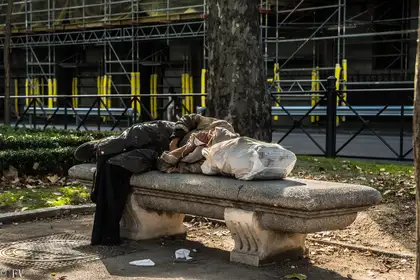
Rather than addressing the causes of inequality, there is a risk that the current approach pushes some of the poorest people in Aotearoa away from the places where we see them. If someone is sleeping rough, begging or simply spending a lot of time in a public place because they have nowhere else to go, moving them on does not make the underlying problem disappear.
It simply changes where the problem is visible.
Writing at another time when inequality was increasing and hideous poverty was everywhere apparent, Karl Marx wrote about the "grotesquely terroristic laws" used to remove marginalised populations from places where they were not wanted.
I am under no misconception that citing Marx will endear me to a wider audience. But there is something worth considering in that observation.
A society can respond to poverty in two ways. It can ask why people are struggling and what can be done to change those circumstances. Or it can decide that the problem is their visibility and find ways to move them somewhere else.
The proposed move-on powers force us to confront which of those approaches we are taking.
If asking another person for a few dollars can be treated as a public safety problem, we should at least pause and ask what exactly we are trying to make safer.
The person asking for help, or the rest of us from having to see that they need it?
Dr Matt Wynyard is a Senior Lecturer in the School of People, Environment and Planning at Massey University.
Related news
Opinion: Change to our built environment is coming, and not only are we not ready, we’re spending money trying to avoid the inevitable
By Professor Elspeth Tilley and Simone Gabriel

Opinion: Healthcare decisions belong to evidence, not headlines
By Associate Professor Margaret Sandham

Opinion: Why the next UN Secretary-General matters to New Zealand
By Associate Professor Damien Rogers