University requirements and number of copies
The University Calendar provides regulations regarding the presentation of theses.
For theses worth 90 credits or more, follow the instructions below.
Theses of fewer than 90 credits are not required to be lodged in the Library. Some theses may be accepted, in digital format only, depending on grade and credit level.
Masterate
Master's students and supervisors should refer to the studying your master’s page for the most recent information, and to download the forms required for thesis submission.
Doctoral
Doctoral students should refer to the Your Doctoral Journey Stream site. Supervisors should refer to OneMassey.
Your Doctoral Journey Stream site
Depositing the thesis to Pātaka Rangahau Massey Research Online
After examination, digital copies of:
- Master’s theses are deposited into the Student Portal for approval by GRS.
- Doctoral theses are deposited in Massey’s institutional repository, Pātaka Rangahau Massey Research Online.
Pātaka Rangahau Massey Research Online
Use the yellow deposit button on the Pātaka Rangahau Massey Research Online homepage and follow the prompts. Please login using a valid personal email and password (not your Massey login).
Mac users may find that they may not be able to sign the interactive RF7 form, so may need to upload a scanned copy of the signed form.
Checklist before depositing
To add your digital thesis to Pātaka Rangahau Massey Research Online, make sure it meets these requirements:
1, Final form
Your thesis must be in its final form with no comments or track changes left in the document.
2, File management
Keep the number of files to a minimum to reduce conversion time and avoid errors. Ensure the file is not security protected or encrypted so that the abstract can be extracted and file properties can be added.
3, Text files
Use Microsoft Office Word compatible or Adobe PDF format.
If using Word, the Library will convert it to PDF for uploading to Pātaka Rangahau Massey Research Online.
Do not secure the documents in any way, as this prevents repackaging.
4, Supplementary thesis material
Use standard file formats for supplementary materials.
Examples: Excel for data, OGG/MP3/MP4 for audio, AVI/MPEG/WMV/MP4 for video.
5, Keywords
Provide keywords that describe the main focus of your research. This will help your thesis be found in internet searches.
6, Copyright form
Include the signed form RF7: Copyright Form and Declaration Confirming Content of Digital Version of Thesis.
Articles or conference papers you authored can be included if you have copyright permission. See below for more on copyright.
7, Storage and availability
The Library only accepts digital copies of both Master and Doctoral theses worth 90 credits or more.
Your digital copy will be included in Pātaka Rangahau Massey Research Online, the open access digital archive that stores the research and scholarship of Massey University.
Format and description
Theses and dissertations shall, unless the University Librarian approves otherwise, conform to the following requirements. If doing a thesis with publications doctoral students should refer to Stream, and supervisors should refer to OneMassey.
Your Doctoral Journey Stream site
Please also refer to the Copyright and Embargoing your thesis sections below.
Order
A. Preliminaries
The order of the preliminaries should be:
- title page
- abstract
- preface and acknowledgements
- table of contents
- list of illustrations and tables.
B. Text
Text should be ordered by:
- main body of the work
- footnotes.
Many theses have the sections in this order:
- introduction
- literature review
- materials and methods
- results
- discussion
- conclusion.
Give the chapters meaningful titles containing words relevant to your thesis. This makes it easier for potential readers to find it when searching online.
C. Reference material
The order of reference material should be:
- bibliography
- appendices.
Format
Title page
The example below shows the wording and layout of the title page.
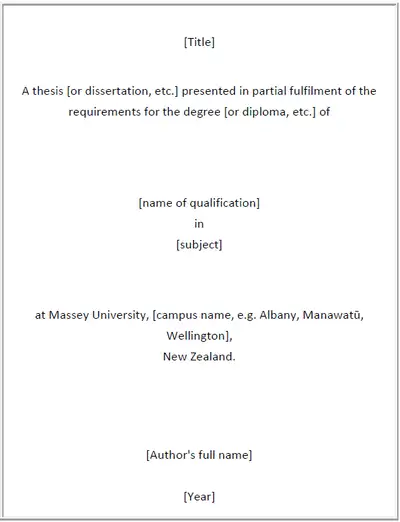
- Title of the thesis centred in the top third of the page.
- Degree, subject and campus details centred in the middle third of the page.
- Author's name and date centred in the lower third of the page.
Year
The year the thesis reached its final version, including any emendations required by the examinations process.
Abstract
A short abstract up to 350 words, suitable for publication, shall be included in the thesis.
Preface and acknowledgements
The preface may describe briefly the scope and purpose of the research. Persons or institutions acknowledged are usually only those who have contributed to the content of the thesis. The extent of their assistance should be indicated. The acknowledgements should also include a statement indicating, if relevant, that approval for the research has been obtained from the appropriate University Ethics Committee for the experiments described in the thesis.
Table of contents
The table of contents lists all significant sections in the order they appear and includes page numbers.
List of illustrations, tables
This is a listing of all illustrative material, photographs, figures or tables, in the order they appear, with page numbers.
Footnotes
Footnotes are used for acknowledging quotations and sources of facts, or for elaboration of a particular point. They are usually numbered consecutively through each chapter and should be detailed at the foot of each page or at the end of the chapter in which they occur.
Bibliography
This should include works cited in the text and footnotes, as well as those of more general significance. Consistency in style of entry is essential; refer to the Style Guide for your chosen style and consult your supervisor. Style guides may be held by the Library, or available online.
Appendices
Appendices include material which applies to the thesis as a whole or to a particular chapter, such as questionnaires or data sheets. Their function is to keep the text uncluttered and reference to them should be made at the appropriate place in the text. If raw data on which the research is based is included, it should be part of the appendices.
Layout
Line spacing and fonts
For doctoral examination, double line spacing is recommended for text, and the final copy may have 1.5 or double line spacing. Masterate students should follow the recommendations of their College. For students who wish to print their own personal hardcopy, we recommend margins of 2.5cm at the top and bottom, and inside margins of 3cm and outside margins of 2cm. Font size should be neither too large nor too small. A size of 10 to 12 point is recommended.
Underlining and italics
These are used for emphasis and for special terms. Titles of books and periodicals are normally in italics.
Figures
Photographs, maps and graphs should be numbered in Arabic numerals. Text references are to be made in brackets and should precede the figure.
Where they are not the author's own work, the source of maps, tables and photographs should be acknowledged, and copyright permission obtained. Refer to the Copyright section below.
Pagination
Preliminary pages, beginning with the title page, should have page numbers in lower case Roman numerals. The main text of the thesis should have page numbers in Arabic numerals. Page numbers should be located in a consistent position throughout the text.
Inserted maps and diagrams should bear a specific identification of their proper location in the text, for example, facing p.7 or between p.15 and 16.
Copyright
You should read carefully Massey University’s Student copyright guide especially the information about images and ensure that your thesis complies with those guidelines. Copyright of a thesis usually resides with the author and is governed by the Copyright Act 1994. Unless you state otherwise, the Library may copy all or part of your thesis and provide it to another institution for the purposes of research and private study.
You may assert your moral right to be identified as the author of the work in a statement to this effect on the verso of the title page.
Third party copyright
Your thesis may include material where you are not the copyright holder, or not the sole copyright holder. This material will usually be either:
- Sections of the thesis written by yourself, but also published as journal articles or book chapters and where copyright was transferred to a commercial publisher. This will be the case with thesis with publications.
- Material such as photographs, drawings or entire poems belonging to another party, of which you reproduced the entire work or more than the proportion allowed by the Copyright Act 1994. This includes diagrams and other datagraphics as these are considered entire works.
Copyright Act 1994
If you wish to include such third party content in your thesis, you will need written permission from the copyright holder.
Who is the copyright holder?
- For books, book chapters, and journal articles, the publisher holds copyright.
- For reports, the issuing body holds copyright.
- For internet resources, the author or website owner usually holds copyright.
For the formats listed above, check the relevant websites for copyright statements and requirements.
- For audio and visual material, including sound recordings, games, software and video, the copyright holder can vary. Look for copyright statements to identify who to contact.
- For privately or non-commercially printed books, the author holds copyright. Look for contact details in the book or use directories or electoral rolls.
- For photos of artworks. If the photos first appeared in a book, please contact the publisher of the book in the first instance. If you took the photos of the original artworks and the creator is alive, seek permission directly. If the creator died less than 50 years ago, the works are still in copyright, and permission must be sought from the creator’s estate.
When seeking permission
When writing to copyright holders, include the following information:
- your name
- the name of the institution where you are studying, i.e. Massey University
- the degree you are completing
- your thesis topic
- the name of the work you wish to use, how much you wish to use and how you wish to use it. Include full reference details.
- a request for permission to make it available online in an open access institutional repository.
You can find a template for a copyright permissions letter in Appendix 1 of Tony Millet’s Copyright guidelines for research students.
You should keep copies of permissions granted. See Appendix 2 of the Copyright guidelines for research students for a sample copyright permissions log.
Frequently asked questions
Frequently asked questions
I’ve published various journal articles that make up part of my thesis – can I include these?
You will need to check whether the journal publishers allow these articles to be placed in an online institutional repository. The Copyright Transfer Agreement (CTA) you signed when the article was accepted should include this. Otherwise the journal article site may have a form for requesting permission or you can check the journal on Open Policy Finder to see if they have a general policy.
I’ve checked but I can’t see anything helpful either in the CTA or Open Policy Finder.
You’ll need to write to the publisher yourself and ask for permission. Include the information given above, and make sure that it’s clear that the article will be made available as part of your thesis, and that it will be publicly available in an institutional repository.
My thesis includes photos of various art works – do I need to get copyright permission for these?
Yes. If the photos first appeared in a book, please contact the publisher of the book in the first instance. If you took the photos of the original artworks and the creator is alive, seek permission directly. If the creator died less than 50 years ago, the works are still in copyright, and permission must be sought from the creator’s estate.
Can I reproduce a diagram or figure from another publication?
Only with the permission of the copyright holder, as diagram or figures are considered to be complete works. They are included in the definition of Artistic Works under the Copyright Act.
I’ve tried my hardest and I can’t track down the copyright holder OR I have, but they have not given me permission.
List the parts of your thesis which do not have copyright permission in a separate file. Add this to the copyright form RF7. These will not be made available electronically – instead there will be a notice indicating that for copyright reasons the material is not available. If the material is a journal article or book chapter, the bibliographic details only will be given.
Thesis with publications
We recommend you request permission to make your publication available online in an open access institutional repository at the time of acceptance, that is, before copyright is transferred. Articles that have an embargo on appearing on institutional repositories are dealt with in the next section.
Further information
Copyright is complex and knowing what is and isn’t covered by copyright is not always straightforward. If you are unsure, please email copyright@massey.ac.nz with questions.
Embargoing theses
Theses should be publicly available unless there are good grounds for restriction of access. Students should read Massey's Thesis Embargo Policy.
The most common grounds are to avoid disclosing:
- commercially sensitive information.
- personal or private information.
- research before the author of the thesis has had reasonable opportunity to publish all or part of the thesis.
- material that has been provided on the condition that it not be disclosed.
Most academic journal publishers do not consider theses as ‘prior publications’ so your thesis being on Pātaka Rangahau Massey Research Online should not prevent articles based on it being accepted. If you are planning to publish from your completed thesis, please check the policies of individual journals or publishers.
Thesis with publications
If a chapter, or chapters, is the accepted manuscript it may be subject to a 12 to 24 month journal embargo period, particularly if you did not obtain permission from the journal publisher to include it in your thesis. In this case, the whole thesis will be embargoed for the required period. Fill out the embargo form as early as possible. Tick ‘other’ and write:
'Chapters [please specify which] already accepted for publication/in print.'
To apply to embargo your thesis:
- Complete the form: Application to Embargo a Thesis.
- In the case of the full digital copy of an embargoed thesis, the author, title, abstract and metadata will still be publicly accessible through Pātaka Rangahau Massey Research Online, while the embargo is in place. Do not include sensitive information in the thesis abstract. If you have concerns, please discuss them when you submit your embargo application to the Graduate Research School, Research and Enterprise.
Contact a subject or Māori services librarian
We're here to help you with your research or teaching. Contact a subject or Māori services librarian by email or book an appointment.