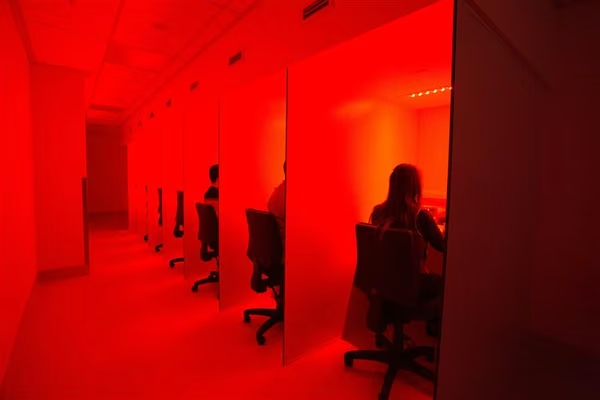
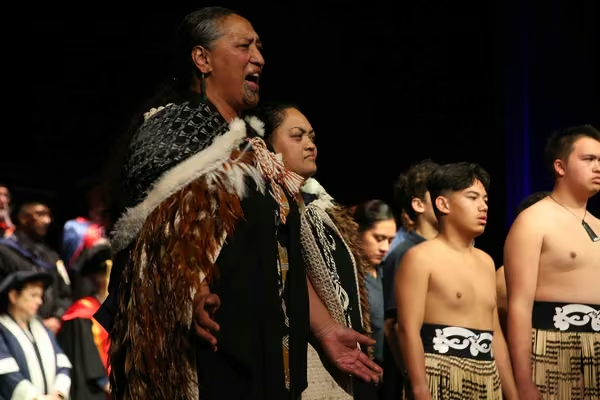
Feast promotes an inclusive and diverse culture. However, we recognise that Māori are underrepresented in STEM (Science, Technology, Engineering, and Mathematics) and under-characterised in food preference studies.
Every year, we offer our Pūhoro internship in partnership with Future Foods Catalyst, the Riddet Institute, and Wakatū Incorporation. We are proud to support and contribute to Māori Consumer and Sensory Science research.
Pūhoro STEM Academy research projects
Feast continue to improve our understanding of kawa and tikanga for conducting our research studies, karakia food samples before presentation to participants, integrate te reo Māori into our daily mahi, and show respect for the head (taonga) in our research, especially when using digital head mounted displays or facial sensors.
We are committed to:
- upholding Te Tiriti principles
- engaging Māori participation in our studies
- providing opportunities for Māori researchers to participate in our science
- engaging with Māori food and beverage entities to co-design research relevant to Māori
- maintaining strong relationships with local Māori community groups.
Participate in a Feast consumer study
Get involved! Māori participants can volunteer to join our consumer studies by email: feast@massey.ac.nz or you can find information about our current studies through our contacts at Best Care Whakapai Hauora in Palmerston North.
Participants selected to take part in this study will receive a thank-you voucher as a koha to cover expenses.
Tapu and Noa in the Feast spaces
To keep our spaces safe and hygienic according to our standard operating procedures (SOPs) sitting on tables is not permitted at Feast. Tables are also considered noa (ordinary) and connected to food, therefore sitting on them would also disrupt the cultural balance between tapu (sacred) and noa.
We keep hats and bags off tables as well as surfaces including benches of sensory booths, ensuring both cultural respect and workplace health and safety procedures. During participant greetings for studies, we also ask them to place their belongings in the lockers located at reception. This helps us maintain an odourless, respectful, safe and uncluttered environment for everyone.
We avoid passing items, including food, over people’s heads. This aims to ensure that our practices reflect both workplace respect and safety. We are also mindful that the head is tapu (sacred), we always ask permission before attaching equipment or items such as VR or EEG headsets to the head or face. These practices ensure that we maintain cultural respect, protect our mana and uphold safe and hygienic workspaces.
Recognising mana
At Feast, we acknowledge the mana of every student and staff by respecting individual differences, their strengths and by seeking to understand people for who they are. We work to create an environment where people feel valued and included through the collective effort of our team and the culture we have intentionally built over time.
Our values guide how we collaborate, communicate and support one another. We prioritise open dialogue, encourage diverse perspectives and create space for everyone to contribute meaningfully to our work. We cultivate a culture where belonging is not just encouraged but embedded in the way we operate every day.
The concept of mana has been a powerful reminder for us that leadership is not only about guiding others but also about creating spaces where students and staff members feel safe to bring their whole selves and thrive. Staying true to our own mana whilst uplifting the mana of others is a principle that reflects how we work and interact at Feast.
Māori data sovereignty
At Feast, we recognise that data security and privacy is crucial. For Māori participants and communities, it also carries cultural significance. We are committed to upholding the mana of Māori data and ensuring our research practices reflect tikanga and our responsibilities under Te Tiriti o Waitangi. Therefore, Feast’s approach embodies:
- Respect for whakapapa and context: we acknowledge that data connected to Māori individuals, communities or environments is more than just information, it is part of a broader cultural and relational system. We treat it with care and respect. Where Māori data is involved, we will seek guidance from Māori collaborators and advisors to ensure decisions about its use, storage and sharing are made in partnership.
- Transparency and reciprocity: we are clear with participants and partners about how data will be used and ensure that findings are shared back in ways that are meaningful and useful to Māori. We do not use Māori data in ways that benefit only the research team or institution. Our work contributes to outcomes that support Māori aspirations and wellbeing.
- Building capability: we will continue to support Māori researchers and students through internships, co-designed projects and training opportunities that build long-term capability in data and research. This approach is part of our broader commitment to manaakitanga (showing care and respect for others), kotahitanga (working together in unity), and tino rangatiratanga (self-determination and empowerment) in all aspects of our mahi (work).
Karakia kai
A karakia kai is said before preparing food samples in the kitchen and/or on the first day of a consumer study. Researchers are encouraged to let participants know that a karakia has been performed in advance of their session, to show respect for the process and provide context for our tikanga.
Karakia kai (Māori)
Karakia kai (Māori)
Mō ngā kai e hora nei kei te mihi
Kei te mihi whakarunga, kei te mihi whakararo
Tūturu whakamaua kia tina, Tina!
Haumi ē! Hui ē Tāiki ē!
Karakia kai (English)
Karakia kai (English)
For the food spread out before us
We give thanks
We give thanks above and below.
Pūhoro STEM Academy research projects
Each year, Feast lab hosts Pūhoro interns to learn more about Consumer and Sensory Science. Our previous projects also include research into perception of kawa kawa as a beverage ingredient (through the Riddet Institute), grape growers and the Māori value proposition.
Seaweed, dumplings, and spring rolls: all part of the menu
The research aim of this Pūhoro internship was to develop prototypes for sustainable ‘future foods’, using ‘karengo’ (‘parengo’ in Eastern dialects) – edible red seaweeds that are indigenous to Aotearoa New Zealand. Māori traditionally harvested karengo from tidal rocks in spring and winter and used it as a winter food source. Savannah Dais developed 3 prototype foods using dried seaweed.
Māori value propositions on food packaging
Genevieve Bell, Ruby Smith and PhD student Summer Wright, analysed how Māori provenance like ‘Made in Aotearoa’ or ‘Kaitiakitanga’ is used in packaging to demonstrate that the business has a connection to Māori culture and encourage ethical purchasing decisions. They also discuss certification as an important tool to prevent exploitation in branding and uphold Māori traditions respectfully.
Consuming concepts: branding Māori future food
Māori future foods have a dual opportunity and challenge of incorporating cultural, social, and environmental imperatives in food product development. Branding is one tool for Māori enterprise to communicate value-led food production.
Summer Wright's research focuses on how Māori future foods are produced and eaten, including how consumers perceived Māori branding.
Māori plant-based foods for a Clean Green Aotearoa
Food provenance is about the origins of food, and what processes are involved to produce it. It is one way of ensuring the authenticity, identity and safety of products. Food marketers are increasingly using provenance to sell a representation of place – a Māori provenance can tell a deeper story about food.
Related content