This page will be updated regularly with new data
If new data is not currently available, please check again soon.
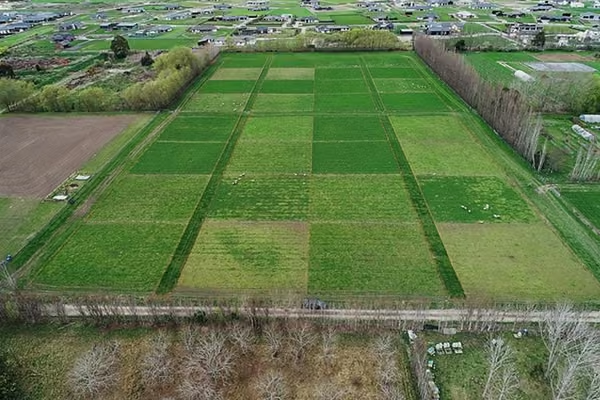
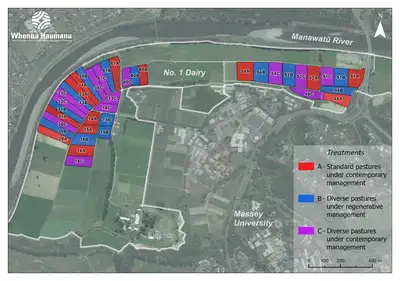
Dairy 1 is one of Massey's working farms. It borders the Manawatū River, within the city boundary. This research site is grazed by dairy cows and includes 3 farmlets:
- Farmlet A – standard pasture under contemporary management
- Farmlet B – diverse pasture under regenerative management
- Farmlet C – diverse pasture under contemporary management
Update
Calving is now complete, and the season’s 1st silage cuts have been made from all 3 treatments.
As a result of cleaning out pastures during winter and the speed of pasture growth, quality is being maintained even with cows pre-grazing at covers of around 3,800 to 4,000 kgDM/ha.
Cows are still to reach peak intake and are currently being offered around 17 kgDM/cow/day, while producing around 1.8 to 2.0 kgMS/cow/day.
Farmlets A and B will continue to use nitrogen fertiliser to maximise growth, while the lower stocking rate on Farmlet B will provide a surplus of pasture to ensure more silage can be made.
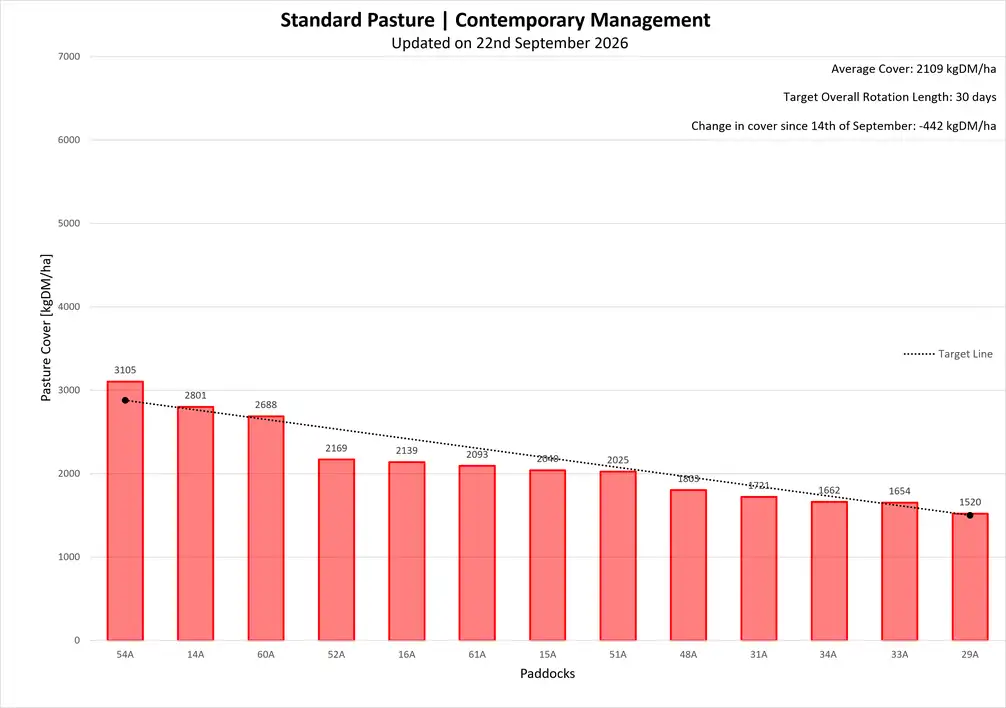
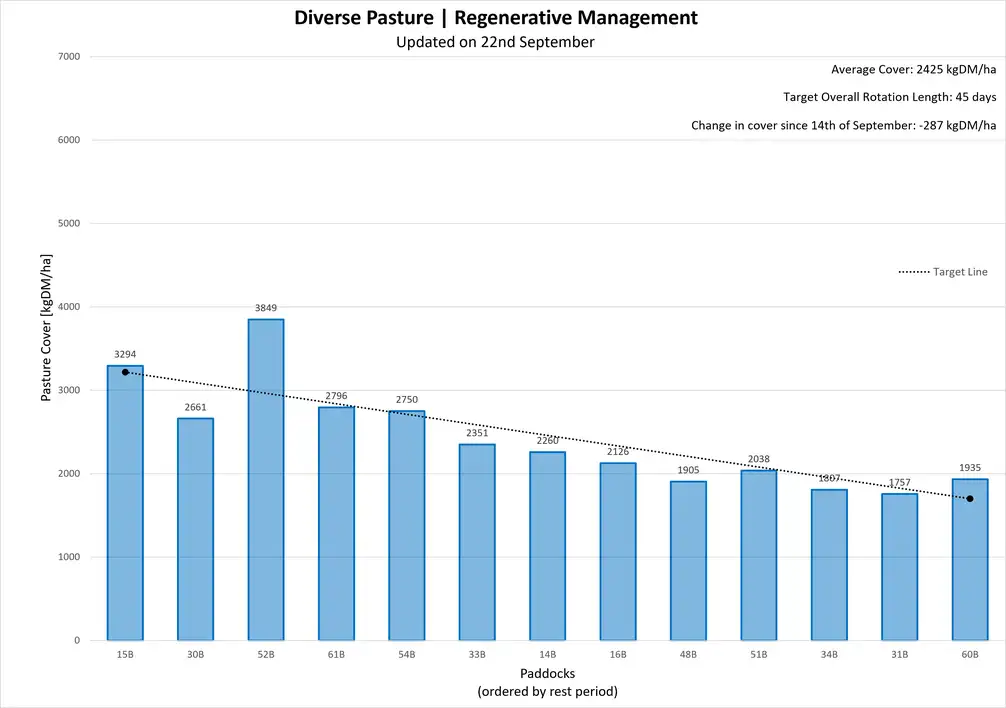
Latest pasture covers
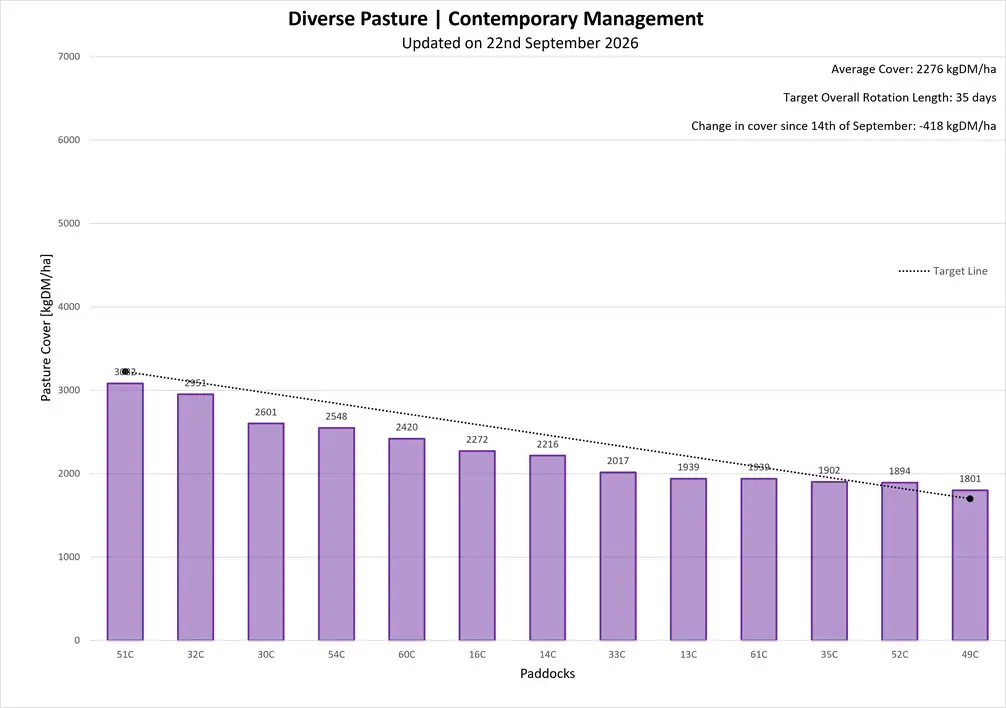
Farmlet data
0-point: 1 June 2026
| Date | Farmlet data | Farmlet A | Farmlet B | Farmlet C |
|---|---|---|---|---|
| 25 September 2026 | Pasture | Standard | Diverse | Diverse |
| Management | Contemporary | Regenerative | Contemporary | |
| Total area (ha) | 12.2 | 12.1 | 12.1 | |
| 25-Sep | Grass area (ha) | 12.2 | 12.1 | 12.1 |
| 25-Sep | Herd size (n) | 33 | 24 | 31 |
| Milkers | Springers | 30 | 3 | 24 | 0 | 26 | 5 | |
| 01-Sep | Average days in milk | 41 | 41 | 40 |
| 01-Sep | Daily production (kgMS/cow/d) | 2.01 | 1.80 | 1.95 |
| 01-Sep | Production - year to date (kgMS/cow) | 82 | 76 | 76 |
| 01-Sep | Production - year to date (kg/ha) | 6.7 | 6.3 | 6.3 |
| 01-Sep | Daily production (l) | 21 | 20 | 22 |
| 25-Sep | Liveweight (kg, n) | 473 (27) | 477 (20) | 480 (26) |
| 11-Sep | Body condition score (n) | 4.7 (32) | 4.5 (23) | 4.5 (31) |
| 01-Jun | Supplement opening stock (total) kgDM/ha | 0 | 116 | 33 |
| 25-Sep | Supplement purchased in (kgDM/ha) | 266 | 165 | 227 |
| 25-Sep | Supplement made (kgDM/ha) | 0 | 0 | 0 |
| 25-Sep | Supplement used (kgDM/ha) | 266 | 231 | 260 |
| 25-Sep | Supplement in hand (total) kgDM/ha | 0 | 50 | 0 |
| 25-Sep | Nitrogen application year to date (kgN/ha) | 62 | 0 | 37 |
| 22-Sep | Average pasture cover (APC; kgDM/ha) | 2110 | 2430 | 2280 |
| 22-Sep | APC change from previous week (kgDM/ha) | -442 | -287 | -418 |
| 22-Sep | Growth rate (kgDM/ha/day) rolling 3 week average | 29 | 39 | 32 |
| 22-Sep | Target rotation length (days) | 30 | 45 | 35 |
| 18-Sep | Residual (kgDmM/ha) 3 day rolling average | 1660 | 1780 | 1630 |
| 25-Sep | Feed offered (Milkers kgDM/cow/day) | 17 | 17 | 17 |
| 22-Sep | Target pasture offered (Milkers, kgDM/cow/day) | 17 | 17 | 17 |
| 22-Sep | Target supplement offered (Milkers, kgDM/cow/day) | 0 | 0 | 0 |
| Soil temperature (°C) | 11.6 |
| Air temperature (°C) | 10.6 |
| Rainfall - MTD (mm) | 106.2 |
Other Whenua Haumanu research sites
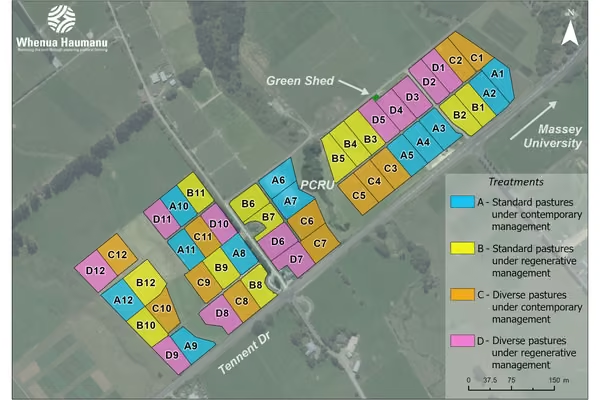
Massey University: Pasture and Crop Research Unit (PCRU)
The PCRU is one of Massey's working farms grazed by sheep and cattle. It includes 4 farmlets: standard pastures under contemporary and regenerative management, and diverse pastures under contemporary and regenerative management.
Lincoln University: Field Research Centre (FRC)
The FRC is Lincoln University‘s hub for applied plant, soil science and ecology research. This research site is grazed by sheep and includes four farmlets made up of 20 plots each.