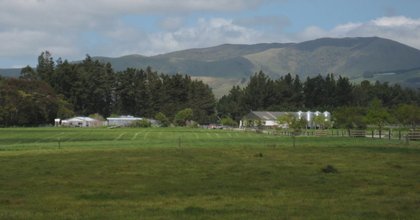
Dairy 4 is one of Massey's working farms and the larger of the 2 dairy blocks, near the Manawatū campus in Palmerston North.
Objectives
- To provide the University with a base for on farm teaching and research .
- To be managed as a profitable, large scale, commercial seasonal supply dairy farm.
- To study the problems inherent to large-scale dairying and to provide a teaching resource for undergraduate and postgraduate programmes.
- To provide a link between Massey University and Agribusiness.
Farm features
About the farm
Dairy 4 is the larger of the two dairy farms owned and run by Massey. In early 2012, half of the Dairy Cattle Research Unit (DCRU) grazing platform joined Dairy 4, and the remainder of the DCRU land (then organic) was dissolved into the Dairy 4 grazing area in early 2013. This has increased Dairy 4’s effective grazing area to 221 hectares.
Location and map
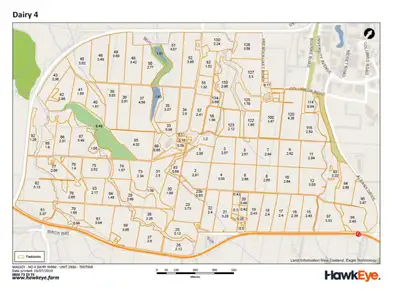
Dairy 4 is located adjacent to the Massey University campus, Tennent Drive (SH57) – approximately 5km from Palmerston North City.
The farm is subdivided into approximately 80 x 1.5-3.5 hectare paddocks all with race access.
Area
250 hectares.
Effective Area: 221 hectares.
Altitude
80 metres above sea level.
Rainfall
980mm (average annual rainfall).
Temperature
An average of 7°C in July and 18.1°C in January (monthly 10cm soil temperature).
Soils
- Predominately Tokomaru Silt Loam with some Ohakea Silt Loam soils on the lower terraces.
- Poor natural drainage and with a tendency to dry out in summer.
- Moderate natural fertility.
- All artificially drained.
Drainage
Tile and mole. Approximately 90% of the farm. Soils are prone to being excessively wet in winter, and dry in summer.
Water supply
Massey University water supply, reticulated to all paddocks.
Staff
Six permanent staff and casual staff as required.
Genetics and breeding
- Breed: Friesian x Jersey herd
- Recorded ancestry: 100%
- Breeding worth: 102/61
- Production worth: 105/71
Facilities
- Milking facility: Waikato Milking 60-bale Centrus platform, ECR Plus, LIC Automation Yield Sense, in-bale teatspray, five way drafting, Nedap cow collars.
- Research: Waikato Milking 28-bale Centrus platform, ECR Plus automation, LIC Automation Yield Sense, in-bale teatspray, 3 way drafting.
- Feed pad: 600 cow capacity. 400 cow commercial and 200 cow research.
- Freestall barn: 200 cow capacity with individual freestalls, plus two open calving areas.
- Calf units: Two calf sheds located in close proximity to the dairy shed, 300 calf capacity.
Pasture
Pastures are predominantly perennial ryegrass / white clover species. Historically, Dairy 4 has grown on average, 11.4t DM/ha/year.
Grazing policies
Pasture based production system with supplements imported (see below) aiming to achieve high levels of feed conversion efficiency through excellent grazing management.
The following stock are grazed off the farm:
- Heifer calves from weaning yearling heifers.
- Jersey breeding bulls from 12 months of age.
- Mixed age dry cows. 150 for 60-70 days.
Regrassing policy
Pastures are renewed on a 10-year rotation. A mixture of Perennial and short-term grasses are used, approximately 20-25 hectares. Any known crop paddocks for the following season are sown with annual the autumn before.
Fertiliser
Fertiliser programmes vary every year. Fertiliser applications are based on biennial soil tests, plant demand and climate data.
Soil tests are done biannually and show the following results:
| Year | pH | Olsen P | SO4 | K | Mg |
|---|---|---|---|---|---|
| 2000 | 5.7 | 65.5 | 8.8 | 5 | 32 |
| 2002 | 5.8 | 45.6 | 8.2 | 6 | 29 |
| 2004 | 5.7 | 39.6 | 9.3 | 6 | 28 |
| 2010 | 5.8 | 39.4 | 14.5 | 5 | 28 |
| 2012 | 5.8 | 43 | 22 | 6 | 27 |
| 2016 | 5.9 | 37 | 17 | 8 | 36 |
| 2018 | 6.1 | 26 | 15.2 | 7 | 34 |
| 2020 | 6.1 | 28 | 13 | 10 | 38 |
| 2022 | 5.8 | 41.9 | 11.5 | 14.3 | 33.4 |
| 2024 | 6.3 | 42.6 | 4.7 | 14 | 39 |
Crops and supplements
Chicory is used as summer cropMaize silage, grass silage, bypass products and concentrates are used throughout the season.
5-10 ha of Maize silage is grown on farm the remainder is sourced externally, along with grass silage. Approximately 500 bales of baleage harvested across the season. Concentrates can be fed in shed. Minerals are provided on a daily basis through the mixer wagon.
Stocking rate and production
| 2018/19 | 2019/20 | 2020/21 | 2021/22 | 2022/23 | 2023/24 | 2024/25 | |
|---|---|---|---|---|---|---|---|
|
Total Milksolids Supplied (kg) |
262,333 | 268,602 | 275,627 | 269,826 | 224,123 | 237,205 | 226,091 |
| Total litres supplied (L) | 3,125,726 | 3,174,513 | 3,279,587 | 3,172,129 | 2,548,992 | 2,680,891 | 2,580,950 |
| Cows Milked (Peak 1st October) | 565 | 575 | 572 | 572 | 551 | 591 | 573 |
| Stocking Rate (cows/ha) | 2.6 | 2.6 | 2.6 | 2.6 | 2.5 | 2.7 | 2.6 |
| Milk Production (kg MS/cow) | 464 | 467 | 482 | 472 | 407 | 401 | 395 |
| Milk Production (kg MS/ha) | 1,171 | 1,215 | 1,247 | 1,221 | 1,014 | 1,073 | 1,023 |
Mating
Mating takes place mid-October for 9 weeks. Artificial breeding only.
| 2018/19 | 2019/20 | 2020/21 | 2021/22 | 2022/23 | 2023/24 | 2024/25 | |
|---|---|---|---|---|---|---|---|
|
Repro 6 Week |
78% | 75% | 74% | 72% | 78% | 72% | 72% |
| Repro Empty | 12.5% | 13% | 15% | 17% | 13% | 10% | 16% |
| Mating AB (Weeks) | 9 | 10 | 9.5 | 9.4 | 9.5 | 9.7 | 9.7 |
| Mating Natural (weeks) | 0 | 0 | 0 | 0 | 0 | 0 | 0 |
| Total Weeks Mating | 9 | 10 | 9.5 | 9.4 | 9.5 | 9.7 | 9.7 |
Our people
Dairy 4 is managed by Fraser Ponsford.

History
Massey University purchased the property of W.J. Brogden (111.3 ha) in April 1973, and the property of L.L. Lovelock (50.6 ha) in July 1973. These two properties were amalgamated and developed by the University for a large seasonal supply dairy farm. In May 1988, the adjoining property of G.W. Perry (58.24 ha) was purchased. Dairy 4 is the larger of the two dairy farms owned by Massey University. In early 2012, half of the Dairy Cattle Research Unit (DCRU) grazing platform joined Dairy 4, and the remainder of the DCRU land (then organic) was dissolved into the Dairy 4 grazing area in early 2013. This has increased Dairy 4’s effective grazing area to 221 hectares.
Read more about the history of Massey
Visit a farm or request research and teaching services
Contact Massey Agricultural and Horticultural Enterprises (MAHE) with questions or to visit a farm. You can also request teaching or research.
More information
You can also email us at: agstation@massey.ac.nz.
Related content