On this page
- Food waste and composting
- Free food for students and all those in need
- Food drive to support students and all those in need
- Student film showcases community meals powered by food rescue
- Advancing food science to reduce hunger
- Research on what makes school meal programmes successful
- Creating ice cream from cosmetically imperfect cauliflowers
- Elderly in aged care are at risk of malnourishment
- Free public lectures on nutrition
- Collaborations with local farmers and food producers
- Related content
Food waste and composting
In 2024, Massey University composted 12,818kg of food waste, compostable packaging items, paper towels and green waste. This is 12% lower than in 2023.
Despite the overall decrease, the Auckland campus had a continued increase, collecting 9,601kg – up 38% from 2023, following a 62% rise the previous year. Compost bins have now been introduced in the self-catered apartments and studios in the Te Ōhanga Village, with a large compost bin located near the community garden.
The Wellington campus collected 1,870kg, down 43% from 2023 but still 64% higher than in 2022.
In contrast, the Manawatū campus saw a significant decline, collecting 1,347kg, a 69% decrease from 2023.
2024 composting by campus:
- Manawatū: 1,347kg
- Auckland: 9,601kg
- Wellington: 1,870kg.
In 2024, Wellington campus became a Community Composting hub. Staff and students are working with the Wellington City Council to trial composting food scraps on site in order to test composting at a community scale. The trial will run until mid-2025.
In an exciting initiative in 2022 and 2023, PreCycle collected paper towels from the Manawatū campus Recreation Centre. PreCycle aims to recycle the towels into construction materials.
Waste audits of the general waste on each campus were carried out in August 2022 using Catalysing Climate Action funding from the Vice-Chancellor.
The audits were in conjunction with PreCycle (Palmerston North), Sustainability Trust (Wellington) and OCS (Albany).
High proportions of compostable waste, mainly food and paper towels, were found on each campus. From this baseline, initiatives are underway to further increase composting levels on all campuses.
Additionally, the Manawatū dining halls have installed Leanpath technology to assess food wastage in dollars and weightage, with the ability to set goals for constant improvements.
Wharerata, the staff cafeteria on the Manawatū campus, and the Manawatū dining halls both support a community food hub, Just Zilch. Leftover daily production gets given to people needing assistance through the hub.
Various Green Impact teams are composting scraps they produce at work, with some teams even aiming for zero food waste to landfill. Examples include:
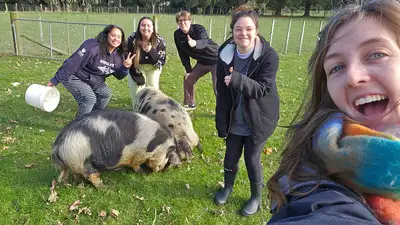
- The Te Paepoto team in Turitea, who collect scraps to feed to the wonderful kune kune Betty and Wilma
- The Ngā Kaitiaki Taiao | Library team in Albany, who feed scraps to their worm farm or take them to the council-run hot composting site.
Free food for students and all those in need
Massey University has partnerships with 2 food rescue organisations, Just Zilch in Palmerston North and Kaibosh in Wellington, to provide free food and essential household items for students in need. Deliveries occur weekly, with goods delivered on Tuesdays in Wellington and when food supplies permit in Palmerston North. We extend our gratitude to Massey’s chaplaincies and the student association Te Tira Ahu Pae for coordinating these services. Additionally, emergency food boxes are prepared for students in financial hardship.
Students, staff or anyone in our community experiencing food insecurity during tough times are also welcome to visit Just Zilch from Monday to Friday to receive food directly.
Food drive to support students and all those in need
In both 2024 and 2025, Massey University teamed up with student association Te Tira Ahu Pae and the City Mission for the Can Can Plus Campaign. In 2024, 8 boxes of canned and dry food were collected, and in 2025 around 160 items were collected. In both years, the food was equally shared between students in need and the City Mission.
Dr Tere McGonagle-Daly, Deputy Vice-Chancellor Students and Global Engagement, was pleased to see staff and students donate to this important cause. "I want to pass on a huge thanks to all those that have donated to the Can Can Plus campaigns. Helping students have access to food when they are in hardship can directly support their studies, as they may struggle with energy levels, focus and stress if they aren’t eating well or regularly.”
Student film showcases community meals powered by food rescue
Student film showcases community meals powered by food rescue
A documentary produced by Bachelor of Screen Arts students in 2024 showcases Kaibosh Kitchen’s mission to transform surplus produce into 300 community meals each week. The film promotes zero food waste and highlights the charity’s wider food rescue efforts across Wellington.
Advancing food science to reduce hunger
Advancing food science to reduce hunger
The International Hydrocolloids Conference was held in New Zealand for the first time in its 32-year history in 2024, marking a major milestone for food science. Chair Distinguished Professor Harjinder Singh, recently awarded the prestigious Pickering Medal by the Royal Society Te Apārangi for his work on iron deficiency and food innovation, highlighted the urgent need for sustainable food systems in the face of global challenges.
Research on what makes school meal programmes successful
Research on what makes school meal programmes successful
New research funded by the Our Land and Water National Science Challenge explored what drives the success of community and school-led meal programmes. Findings show that school meals are more effective and create less food waste when they offer familiar, enjoyable foods.
Additional research on the Ka Ora, Ka Ako free lunch programme found it improved student outcomes, reduced food insecurity and fostered a stronger sense of community and belonging.
Creating ice cream from cosmetically imperfect cauliflowers
Creating ice cream from cosmetically imperfect cauliflowers
EatKinda cauliflower vegan ice cream, co-developed by a Massey student and winner in the recent KiwiNet Research Commercialisation Awards, uses cosmetically imperfect food supermarkets can't sell.
EatKinda received investment and support through the Massey Ventures Student Investment Fund and recently won the Momentum Student Entrepreneur category in the 10th annual KiwiNet Research Commercialisation Awards.
Elderly in aged care are at risk of malnourishment
Elderly in aged care are at risk of malnourishment
Recent Massey research found that 83% of residents in 3 rest homes were malnourished or at risk of malnutrition. The findings highlighted the need for regular malnutrition screening in residential aged care.
Free public lectures on nutrition
Free public lectures on nutrition
Massey hosted a series of free nutrition webinars for the public in 2021 and 2022 as part of World Iron Awareness Week.
Collaborations with local farmers and food producers
Massey shares its knowledge and expertise about sustainable agriculture with many local farmers and food producers.
Tiaki Wai Catchment Solutions Field Day – June 2023
Tiaki Wai Catchment Solutions Field Day – June 2023
This day attracted over 60 participants eager to learn about improving waterways on farms. The event featured practical demonstrations and presentations providing valuable insights to attendees.
Whenua Haumanu project
Whenua Haumanu project
As part of the university's Whenua Haumanu project, Massey:
- Collaborated with 10 Taranaki farmers committed to practising regenerative agriculture. The team is employing a participatory and co-design approach. This initiative aims to improve sustainable farming practices in the region.
- Hosted a Field Day at Massey in November 2024 which was attended by more than 200 people. Attendees included farmers and other rural professionals, industry groups and scientists. Visitors toured Massey’s sheep and dairy farms to learn about regenerative and contemporary farming practices across both standard and diverse pastures, and explored early project results, research methodologies, and practical applications for their own farms.
- Hosted 2 hands-on pasture identification workshops in Taranaki and Manawatū, engaging a total of 32 farmers in December 2022 and March 2023.
- Hosted a Visual Soil Assessment (VSA) training workshop by Graham Shepherd and attended by 45 farmers, researchers and students in October 2023. The VSA is a simple field method published by the Food and Agriculture Organisation and used internationally to assess soil health.
The project and its associated research were presented and discussed with:
- 30 Taranaki farmers, advisors, agriculture teachers and government agency staff in May 2023
- a group of 40 farmers from the B+LNZ Next Generation group in May 2023
- a group of 22 farmers from the Beef and Lamb, Western North Island Farmer Council in June 2023
- More than 200 people at the Whenua Haumanu Field Day in November 2024.
Sustainable Farming Fund Field Day
Sustainable Farming Fund Field Day
In November 2022, Massey hosted the Sustainable Farming Fund Field Day, tailored for local farmers and rural professionals.
The event showcased several demonstrations unveiling innovative methods to protect waterways on farms. Attendees also benefited from presentations covering the latest research in sustainability, insights into upcoming projects, and perspectives from industry and regional councils.
Short courses on sustainable agriculture
Short courses on sustainable agriculture
Massey offers a series of short courses on sustainable agriculture for rural professionals, including local farmers and food producers. Courses cover agricultural greenhouse gas emissions, sustainable nutrient usage and environmentally friendly water plans.
Please see the Agriculture section of our Short Courses page
Massey research farms and facilities
Massey research farms and facilities
Massey’s Farmed Landscapes Research Centre has a range of research facilities available, including controlled glasshouses, laboratories and equipment. They are often used in collaboration with local farmers and food producers to investigate and improve sustainable farming practices. Massey’s research farms also get used for many collaborative research projects. Ongoing research covers climate change mitigation, sustainable nutrient management and Smart Farming with precision tools and technologies.
The Farmed Landscapes Research Centre also offers services to local farmers, including conducting research, product evaluations and analytical services for soil, plant and water.
Piggie workshop: a food waste event for families
Piggie workshop: a food waste event for families
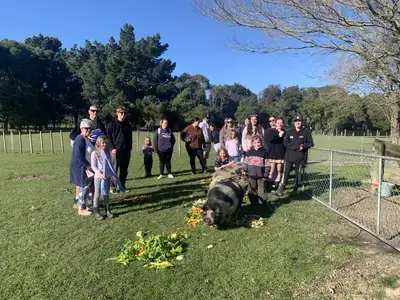
In 2025, the Te Paepoto Seedlings Green Impact team hosted a fun, family friendly event focused on responsible consumption and reducing food waste.
Families learned practical, sustainable ways to manage uneaten food – from worm farming and composting to feeding food scraps to animals.
Children and parents enjoyed interactive talks, completed custom worksheets, decorated pig-shaped biscuits. They even met Betty and Wilma, 2 friendly kune kune pigs who happily munched on leftover scraps.
The workshop was a great success, bringing together colleagues and their families to learn, share and take action for a greener future.
Related content