The quality of information varies widely. You need to evaluate it carefully, to see whether it is reliable, accurate and suitable for your purpose.
To evaluate sources you should:
- look critically at information to determine its relevance, suitability and reliability
- be critical and sceptical about sources and information to ensure authenticity
- check for accuracy, validity and currency as measures of information quality
- make sure all information and resources are fit for purpose.
Choosing scholarly (peer-reviewed) articles is a shortcut to knowing sources are reliable. Discover and many other library databases let you easily filter to these.
For other sources, use these models to help with your evaluation:
Te Whatu Aho Rau - He Anga Arotake
Te Whatu Aho Rau - He Anga Arotake A holistic Māori-informed view of the information evaluation process

Te Whatu Aho Rau evaluation framework
The Te Whatu Aho Rau - He Anga Arotake information evaluation framework is a re-imagination of the Rauru Whakarare Evaluation Framework. It provides a holistic Māori-informed view of the information evaluation process.
Te Whatu Aho Rau was created by Massey University colleagues Angela Feekery and Reupena Tawhai.
Go to the full Te Whatu Aho Rau - He Anga Arotake.
CRAAP test
CRAAP test Currency, Relevance, Authority, Accuracy, Purpose
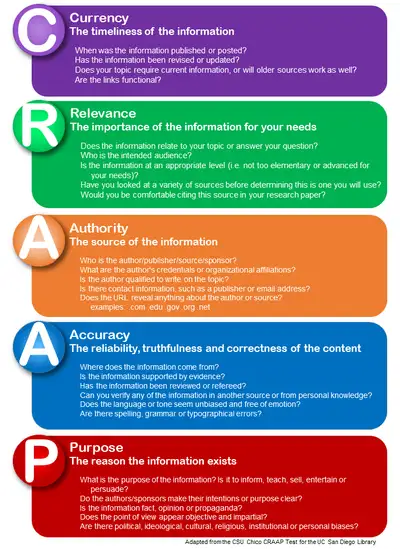
The CRAAP test, adapted from the CSU Chico CRAAP test for UC San Diego Library
- Currency
- Relevance
- Authority
- Accuracy
- Purpose
Visit the Preuss School CRAAP test or the Wintec CRAAP test
Lateral reading / fact checking
Lateral reading / fact checking Read about a source on other trustworthy sites
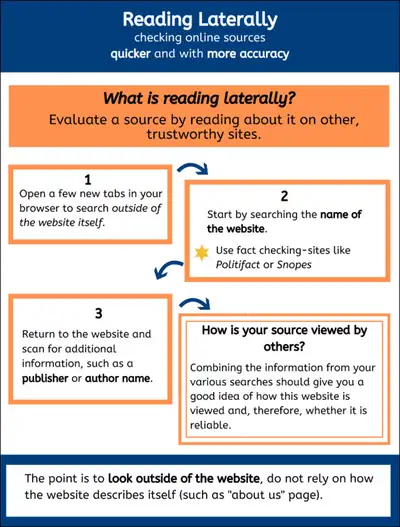
Reading laterally, by Joanna Novick, Milton Academy
Evaluate a source by reading about it on other trustworthy sites.
Visit NWACC What is lateral reading? or CSUN Reading laterally for fact checking
SIFT (the four moves)
SIFT (the four moves) Stop, Investigate, Find, Trace
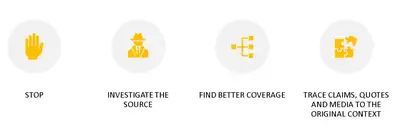
SIFT, by Mike Caulfield, adapted with a CC BY 4.0 license.
- Stop
- Investigate the source
- Find better coverage
- Trace claims, quotes, and media to the original context
Visit SIFT (the four moves)
Ask a librarian
We're here to help you find the resources you need for your study. Ask a librarian by email, over the phone, or at a service point in any campus library.
Auckland campus library
Auckland campus library
- Library@massey.ac.nz
- Free phone inside New Zealand
- Phone outside New Zealand
- Location
Postal address
Library
Private Bag 102904
North Shore Mail Centre
Auckland 0745Physical address
Library
Gate 1, East Precinct
Albany Expressway (SH17)
Albany
Auckland 0632
Manawatū campus library, Palmerston North
Manawatū campus library, Palmerston North
- Library@massey.ac.nz
- Free phone inside New Zealand
- Phone outside New Zealand
- Location
Postal address
Private Bag 11054
Palmerston North 4442Physical address
Tennent Drive
Palmerston North 4410
Wellington campus library
Wellington campus library
- Library@massey.ac.nz
- Free phone inside New Zealand
- Phone outside New Zealand
- Location
Postal address
Massey University Library
Private Bag 756
Wellington 6140
Physical address
Massey University Library
Block 5
63 Wallace Street
Wellington 6021
Online and distance contacts
Online and distance contacts
- Library@massey.ac.nz
- Free phone inside New Zealand
- Phone outside New Zealand