APA in-text citations
Learn how to format all your resources in APA style in-text citations.
APA reference list
Learn how to format all your resources in APA reference lists.
Audio & visual material
Learn how to format audio and visual material, including podcasts, film and TV broadcasts in APA reference lists.
Books
Learn how to format books, book chapters, edited books, online books and eBooks in an APA reference list.
Journals
Learn how to format journal articles in an APA reference list.
Online material
Learn how to format online material, including AI platforms, social media, websites and apps in APA reference lists.
Other material
Learn how to format other material in an APA reference list.
6th v 7th edition
Compare the changes between the 6th and 7th edition of APA style.

How to reference tutorial
Watch this online tutorial to learn how to reference according to APA guidelines. This 3-part tutorial covers when to include citations, how to write citations using APA Style and how to format an APA reference list.
APA is the most common referencing style used at Massey.
APA formatting
Generally, your assignment instructions or course guide will tell you how to format your writing and what font and line spacing to use. You should ask your lecturer or course coordinator for guidance if they don't.
If your lecturer refers you to OWLL, follow Massey's general formatting and layout guidelines.
If you are told to use APA formatting and layout, this page outlines aspects of formatting according to the APA Style Guide (7th ed.).
Fonts
Fonts
APA allows a variety of fonts.
Serif fonts include 12-point Times New Roman, 11-point Georgia or normal 10-point Computer Modern (the default font for LaTeX).
Sans serif include 11-point Calibri, 11-point Arial or 10-point Lucida Sans Unicode.
Be consistent with your font throughout your assignment, with the following exceptions:
- Figures: Within figures, use a sans serif font with a size between 8 and 14 points.
- Computer code: Use a monospace font such as 10-point Lucida Console or 10-point Courier New.
- Footnotes: Use the default font settings in your word processing software. The footnote font is likely to be smaller than the text font and have different line spacing. It is not necessary to change it.
Lists
Lists
Bulleted lists
Use bulleted lists to draw attention to the items of lists without implying the items go in a particular order.
Use the bullet list function on your word processing software to automatically indent the list. You may use other symbols, such as squares and dashes.
If bullet list items are complete sentences, start each list item with a capital letter and finish with a full stop or other appropriate punctuation.
Example
When undertaking statutory interpretation, look to the dictionary, ordinary usage and context within the statute to ascertain the natural and ordinary meaning of the issue word (Penk & Russell, 2009):
- Dictionary involves referring to well-known dictionaries for definitions of the issue word in the same sense and tense.
- Ordinary usage involves creating example sentences of the issue word to support your argument.
- Context involves looking at the issue word in other places in the statute and considering the meaning of the words about it.
If bullet list items are words or phrases, such as incomplete sentences, begin each item with a lowercase letter unless they are proper nouns.
There are 2 options for the end of bullet list items:
- No punctuation, including the final bullet point list item.
- Use a semi-colon at the end of each bullet list item, particularly if the list item is long with commas. Add a full stop to the final list item.
Example list without punctuation
When undertaking statutory interpretation, look to the dictionary and ordinary usage to ascertain the natural and ordinary meaning of the issue word:
- referring to the dictionary for examples
- ordinary usage examples of the issue word
- context about the issue word (Penk & Russell, 2009)
Example list with punctuation
When undertaking statutory interpretation, look to the dictionary and ordinary usage to ascertain the natural and ordinary meaning of the issue word:
- dictionary, which refers to the dictionary;
- ordinary usage, with sentences including the issue word;
- context, where other uses in the statute and words about the issue word are considered (Penk & Russell, 2009).
Numbered lists
Use numbered lists when list items are ordered in a series, for example, steps in an experiment and itemised conclusions. List items are complete sentences or paragraphs. Use lettered or bullet point lists for phrases or words.
Use the numbered list function on your word processing software to automatically indent the list. Choose Arabic numbers followed by a full stop. The number should not be enclosed or followed by brackets. For example:
The experiment involved a number of steps:
- A hypothesis was developed that anticipated participants would replicate the results of the original experiment.
- Participants were given instructions and asked to read thoroughly.
- The experiment began and participants completed the tasks within the allocated time.
- Participants were debriefed and told they would be sent the results and analysis as soon as practicable.
- Data were collated and analysed.
Lettered lists
You can add letters to a list in a sentence to draw more attention to the items and emphasise to the reader that each item is distinct from the others.
Use a semi-colon to separate list items that contain a comma. The list ends with a full stop. In APA, numbers in brackets are not used in a list. For example:
Participants were categorised by geography, where (a) the Manawatū included Palmerston North, Feilding and Ashhurst; (b) Waikato which included Hamilton, Cambridge, and Te Awamutu; and (c) Taranaki which included New Plymouth, Hāwera, and Stratford.
Learn more about lists on APA Style: Mechanics of style – Lists
Numbers
Numbers
In general, write numbers zero to nine as words and use numerals (Arabic numbers) above 10, for example, 10, 45, 232.
However, there are exceptions for using numerals under 10:
- A number immediately before a unit of measurement: 5 m, 2 kg.
- Statistical or mathematical functions: divided by 5, 95% CI [3.2, 8.4].
- Fractions (except common fractions), decimals, percentages, ratios, percentiles: 34/35, 1.7, 50%, 2:1 ratio, the 5th percentile.
- Time and date: 4 s, 7 mins, 2 days, about 3 days ago, July 4, 1:04 p.m.
- Age: 2 years old, 5-year-olds, 5-year-old-children.
- Scores and points on a scale: I got 6 on a 9-point scale.
- An exact amount of money: $5, $20 USD.
- A numeral as a numeral: the number 3 on a calculator.
- Indicating a place in a series or part of a book, table or figure if the number is after a noun: see Figure 4, book 7, chapter 6. You should use words when the number precedes a noun, for example, the tenth book in the series, the thirteenth row.
Use words to express numbers for 10 and above when:
- starting a sentence, title or heading: Forty percent of cows were treated, and the remaining 60% were not
- common fractions: one-fifth of people, half the day, two-thirds majority.
Learn more about numbers on APA Style: Mechanics of style – Numbers
Abbreviations
Abbreviations
An abbreviation can be a shortened form of a word. For example, 'phone' is the abbreviation of 'telephone'. An abbreviation can also be an acronym which uses the first letter of words comprising a title or phrase. For example, the acronym for Geographical Information System is GIS. Do not use full stops between letters in an acronym. For example, CIA, not C.I.A.
Consider the readers' familiarity with the abbreviation, as unfamiliar abbreviations can be confusing and undermine clarity.
Write out the name in full before using an acronym for the first time. For example, The United Nations (UN). Use square brackets in parenthetical citations. For example, (Ministry of Business, Innovation, & Employment [MBIE], 2017).
APA recommends only providing acronyms for terms you refer to more than 3 times in your document. In subsequent citations, just use the acronym and don't switch between the full term and the acronym.
Learn more about abbreviations on APA Style: Mechanics of style – Abbreviations
Capitalisation
Capitalisation
Words are lowercase unless there is a specific rule to capitalise them, such as the first word in a sentence or a proper noun – the specific name of people, places and things.
Names of racial and ethnic groups are proper nouns, which means they are capitalised. For example, Māori, First Nations, African-American, Asian, Pākehā.
Capitalise trade names, such as Wellbutrin and Coke, but not generic names, such as bupropion and cola.
Capitalise a job title or position when it precedes a name, for example, Dr Walker, President Lincoln.
Don't capitalise when the title or position is used alone or after a name, for example Jane, who is a doctor, the president of the company, registered nurses.
Capitalise the first letter of each word more than 3 letters in the title of a source that is part of a greater work, such as a journal article, a book chapter or a news article referred to in your text. Note this is different from how you format the title in a reference list. For example, In "Lex Aotearoa", Justice Williams.
Learn more about capitalisation on APA Style: Mechanics of style – Capitalization
Italics
Italics
Use italics sparingly.
- First introducing or defining a key term or phrase: Enhanced greenhouse effect describes. Do not italicise subsequent discussion of the term or phrase.
- Referring to the title of a standalone work, such as a book, report, webpage or newspaper in-text: In the Visual history of the world. Note, this is different to how you format standalone titles in a reference list. Don't italicise titles that are part of a larger work, such as journal articles, book chapters or news articles, in the reference list.
- Citing a journal in your reference list. Italicise journal titles and the journal number but not the comma between the title and number nor the issue number. For example, Journal of Qualitative Methodology, 2(3), 34–43.
- When English letters are used as statistical symbols or algebraic variables: SD, n, 2x + 3y.
- Giving the meaning of a number on a scale: on a Likert scale (1 = strongly disagree to 10 = strongly agree).
- Using a non-English word, phrase or abbreviation that does not appear in an English dictionary and the reader is unlikely to be familiar with: He shouted xin nian kuai le!
Learn more about italics on APA Style: Mechanics of style: Italics and quotation marks
Tables and figures
Tables and figures
Referencing tables and figures
APA has strict rules about crediting reproduced or copied images, figures or tables. Include a footnote and a full reference stating that permission was sought to use the table or figure.
However, this level of detail is unnecessary unless your assignment will be professionally published.
Instead, treat the image as a direct quotation. Provide a citation in the caption, with author, year and page number. The source should also have an entry in the reference list.
Formatting table and figures
Generally, your assignment instructions or course guide will tell you how to format your writing and what font and line spacing to use. If they do not, ask your lecturer or course coordinator for guidance.
Learn how to format table and figures at APA Style
Formatting tables
The descriptive title for a table goes above the table.
Place the table after the paragraph first mentioned. Smaller figures may fit on the same page, but larger ones may need to be placed at the top of the next page.
Number each table with an Arabic number in bold in the order first mentioned in your text. For example, Table 1, Table 2 and Table 3. Do not refer to a table by its position relative to the text, for example, 'the table below,' or its page number, for example, 'the table on page 12'. Do not use suffix letters such as Table 5a, Table 5b.
The title should be descriptive but not too long. Put the title in italics and capitalise the first letter of each major word – usually words with 3 or more letters. Give the descriptive caption on a new line under the table number.
Example
Table 1
Covariances of 10 Weighted Industry Portfolios from Mar. 2014 to Mar. 2019
Use 12-point font, double-spacing and 2.54-centimetre (1-inch) margins, unless otherwise specified. Landscape orientation is often used to fit tables on a single page.
Ensure each column (or row) has a clear heading.
Label tables in appendices using capital letters, for example, Appendix A, Table A1, Table A2, Table B1 is the first table in Appendix B.
Use parenthetical citations (author, year) within each cell for multiple sources in a table.
If you have multiple sources within the same table, use superscript letters and provide full references in notes below the table.
Example
Table 1
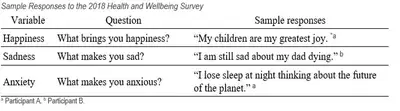
Limit the use of lines (rules) in your table. Usually, you would eliminate the vertical lines in APA style.
Formatting figures
The figure number and descriptive caption for a figure go above the figure.
Place the figure after the paragraph it is first mentioned. Smaller figures may fit on the same page, but larger ones may need to be placed at the top of the next page.
Number each table with an Arabic number in the order first mentioned in your text. For example, Figure 1, Figure 2 and Figure 3. Do not refer to a figure by its position relative to the text, for example, 'the figure below', or its page number, for example, 'the figure on page 12'. Do not use suffix letters such as Figure 5a, Figure 5b.
The title should be descriptive but not too long. Put the word 'Figure' and figure number in bold. Put the title in italics, using title case and describe what is presented in the figure. Give the descriptive caption on a new line under the figure number.
Example
Figure 1
A Flowchart of Data Collection Methodology Used in Experiment 1
Use 12-point font, double-spacing and 2.54-centimetre (1-inch) margins. Check with your assignment instructions or lecturer for specific formatting requirements. You may use landscape orientation to keep the figure on a single page.
If your appendix includes a figure, identify which appendix with a capital letter. For example, Figure A1 is the first figure of Appendix A, Figure A2, is the second table of Appendix A, Figure B1 is the first figure of Appendix B.
Learn how to set up figures in APA Style
Punctuation
Correct punctuation is essential in academic writing. Make sure you understand the punctuation requirements for APA.
Serial commas
Serial commas
APA uses serial commas, sometimes called an Oxford, Harvard or series comma. This means a comma is between the second-to-last and last item in a list.
With a list of 3 or more items, use commas between each item, not just the first 2 items, for example, 'commerce, religion, and politics'. This rule applies to the reference list, all in-text citations and text.
List example
Participants were categorised by geography, where the Manawatū included Palmerston North, Feilding and Ashhurst; Waikato which included Hamilton, Cambridge, and Te Awamutu; and Taranaki which included New Plymouth, Hāwera, and Stratford.
Reference list entry example
Fang, Z., Khan, V., & Zhang, H. (2022). Research ethics in New Zealand: A student guide. Rata Press. (2021). Demystifying academic writing: Genres, moves, skills, and strategies. Routledge. https://doi.org/10.4324/9781003131618
This applies to in-text citations where there are more than 3 authors, which may need to be included for sources with identical authors and dates.
Examples
(Jenson, Yan, Khan, et al., 2010)
Singh, Shaw, Tuhoro, and Westbrook (2020)
Semi-colons
Semi-colons
Use a semi-colon to separate list items that already have commas. End the list with a full stop.
Use semi-colons to separate citations within brackets.
In-text citation example
(Durie, 2023; McShane & Travaglione, 2023; Ministry of Education, 2023).
Quotation marks
Quotation marks
Aside from when you quote, there are other situations where quotation marks may be used:
- Referring to a letter, word, or phrase as an example of itself or when reproducing verbatim instructions or stimuli. For example, the letter “s”; he wrote “I do”; They selected “orange”; The first question was “How often do you shower?”; The stimulus words were “red” and “green”.
- Around the title of something that is part of a greater work, such as an article or book chapter, when referred to in-text. Note this is different from how it is formatted in your reference list. For example, In “The Trial of Mr Peabody,” it was seen.
- Referring for the first time to a word or phrase used ironically, as slang or as an invented or coined word or expression. For example, She was “happy”; He carefully chose his “fit”; A “poonami”.
Learn more about quotation marks on APA Style: Mechanics of style: Italics and quotation marks
Other punctuation
Other punctuation
Spacing after a full stop
Use 1 space after a full stop, question mark or any other punctuation mark at the end of a sentence.
Double brackets
Do not use double sets of brackets. Separate text within brackets with a semi-colon.
| Do | Don't |
|---|---|
| (e.g., England, Scotland; Codd, 2005) | (e.g., England, Scotland) (Codd, 2005) |
Headings in APA
You may need to put headings in your assignment, particularly for reports and longer documents. Check your course guide or with your course coordinator about the formatting requirements for your assignment.
Often, shorter essay-type assignments don't need headings at all.
Learn more about headings at APA Style
For all heading levels:
- use title case – all major words should start with a capital letter
- use the same font style and size as the rest of the assignment
- do not give the heading a number or letter.
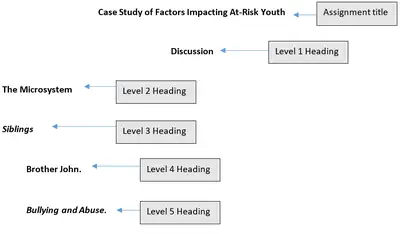
Level 1 headings
Level 1 headings
Use level 1 headings for the main sections of your assignment, such as the methods, discussion and conclusion. The introduction does not need a heading – your title and first paragraphs are understood to be introductory and the heading 'introduction' is unnecessary.
Your assignment title should be at the top of the first page and your first few paragraphs should clearly introduce your topic and intent.
Level 1 headings should be centred, bold and title case. Text following the heading should be a new, indented paragraph.
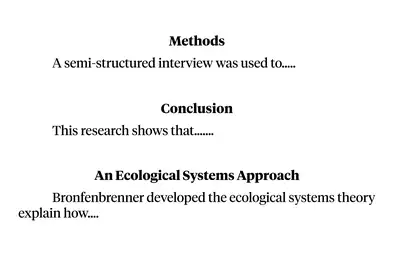
Level 2 headings
Level 2 headings
Use level 2 headings to introduce subsections within the main sections. Level 2 headings should be flush with the left margin, bold and title case. Text following the heading should be a new, indented paragraph.
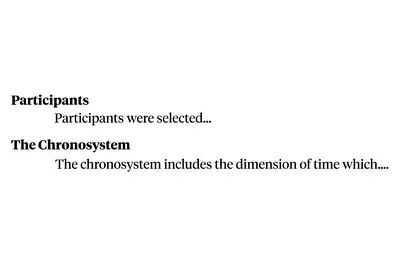
Level 3 headings
Level 3 headings
Use level 3 headings to break your level 2 subsections into smaller sections. Level 3 headings should be flush with the left margin, bold, in italics and title case. Text following the heading should be a new, indented paragraph.
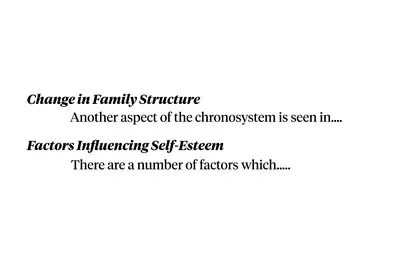
Level 4 headings
Level 4 headings
Use level 4 headings to break level 3 subsections into smaller sections. Level 4 headings should be indented like a new paragraph, bold, title case and end with a full stop. Unlike heading levels 1 to 3, you should begin the text on the same line as the heading – format text the same as a regular paragraph.
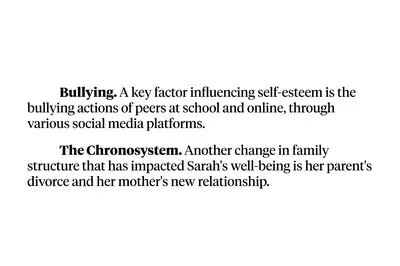
Level 5 headings
Level 5 headings
Use level 5 headings to break level 4 subsections into even smaller sections. Level 5 headings should be indented like a new paragraph, bold, in italics, title case and end with a full stop. Like level 4 headings, you should begin the text on the same line as the heading – format text the same as a regular paragraph.
Example of APA heading levels
Example of APA heading levels
APA Style and grammar guidelines
Find style and grammar guidance on referencing, headings, tables, figures, language and tone on the APA official website.
You can also access the APA Publication Manual through the Massey Library. The manual provides detailed guidance on referencing, headings, tables, figures, language and tone.
Publication manual of the American Psychological Association (7th ed.) (Massey Library login required)
Get help from the Centre for Learner Success
The Centre for Learner Success work with students of all levels, studying on campus or online. Our Learning Advisers and Writing Consultants can support you with an assignment or help you improve your writing and study skills – either one-on-one or in a small group.
Submit a draft of your assignment to the Assignment Pre-reading Service and receive detailed, individual written feedback on how to improve your academic writing – including structure, focus, flow, style and referencing – before you submit your assignment for marking.
Centre for Learner Success
Centre for Learner Success
- Phone
Centre for Learner Success – assignment pre-reading service
Centre for Learner Success – assignment pre-reading service
- pre-reading@massey.ac.nz
- Phone
+64 695 165 47
Related content