On this page
Objectives
- To expand knowledge about pastoral sheep and beef farming in summer-dry areas, particularly Wairarapa.
- To provide a facility for quality research, teaching and extension in sheep and beef farming.
- To be managed as a profitable commercial sheep and beef farm.
- To provide a link between the University and Agribusiness.
Farm features
About the farm
Riverside Farm is owned by the Sydney Campbell Foundation. Massey has leased the land since 1978 based on a 99-year term (with right of renewal).
The farm consists of 2 blocks, the main unit (650 ha) and the smaller and less developed Mikimiki block (75 ha).
The property is subdivided into 105 paddocks and 5 holding paddocks. Fences are about 50% conventional and the rest 3- or 4-wire electric.
Location & map
The main block is located approximately 11km north to north-west of Masterton, with land bounding SH2 and Mikimiki Road. The Mikimiki block is located approximately 6km west of the SH2.
Area
725 hectares.
Effective Area: 686 hectares.
Altitude
Main block
200–300 metres above sea level.
Mikimiki block
300–400 metres above sea level.
Contour
| Contour type | Hectares | Per cent |
|---|---|---|
| Flat to undulating | 480 | 70 |
| Rolling | 100.0 | 14.5 |
| Strongly rolling | 80.0 | 11.6 |
| Moderately steep | 26.0 | 3.9 |
Noxious weeds
Variegated and nodding thistles.
Noxious animals
Rabbits, hares, deer.
Soils
Main block
- Kohinui series and Tauherenikau series (intergraded yellow-brown loam and yellow-brown earth) dominate the terrace between the river and the State Highway, with recent soils (Greytown series) surrounding the current river bed.
- Soils of the Kohinui series also occur on the western side of the river, bounding with the Konini hill soils that mantle the hills on the north of Mikimiki Road (with a small proportion of Mikimiki steepland soil also occurring).
- History Kaikouta series limestone hill soils dominate south of Mikimiki Rd and west of the river, with Otukura series gleys in the south-west and some Konini series mudstone hill soils also present.
Mikimiki block
Mikimiki steepland soils (greywacke).
Climate
The nearest recorded Council weather station to Riverside Farm:
| January | February | March | April | May | June | July | August | September | October | November | December | Year | |
|---|---|---|---|---|---|---|---|---|---|---|---|---|---|
| Average high C | 24.3 | 24.0 | 21.9 | 18.8 | 15.4 | 13.2 | 12.1 | 13.1 | 15.4 | 17.5 | 19.8 | 22.1 | 18.1 |
| Daily mean C | 18.1 | 17.7 | 16.3 | 13.1 | 10.5 | 8.6 | 7.6 | 8.4 | 10.5 | 12.3 | 14.2 | 16.4 | 12.8 |
| Average low C | 11.8 | 11.4 | 10.6 | 7.5 | 5.5 | 4.0 | 3.1 | 3.7 | 5.6 | 7.1 | 8.7 | 10.7 | 7.5 |
| Rainfall mm | 44.4 | 68.9 | 84.5 | 54.0 | 93.6 | 105.3 | 90.9 | 86.7 | 73.7 | 77.2 | 77.5 | 70.9 | 922.9 |
| Average rainy days | 7.1 | 7.6 | 10.1 | 9.2 | 11.0 | 13.2 | 14.1 | 14.1 | 11.7 | 12.8 | 10.0 | 9.7 | 129.8 |
| % humidity | 76.0 | 82.9 | 84.2 | 87.0 | 89.5 | 91.3 | 91.1 | 89.6 | 83.5 | 79.0 | 78.8 | 76.9 | 84.2 |
Riverside receives closer to 1300mm rainfall. Prone to summer droughts and severe Easterly storms. January, February and March are the driest months with June and July typically the wettest period. 1800mm on farm.
Water supply
Water is sourced from the Waiau River and pumped to a tank on top of one of the hills. From there it is gravity-fed back through most of the farm. About 15 paddocks have either dams or creeks for water.
The Mikimiki Block has a gravity-fed reticulated water supply, sourced from an internal spring.
Farm buildings
| Farm building | Occupant |
|---|---|
| Riverside homestead | Farm Manager |
| Second house | Shepherd General |
| Third house | Rented |
All houses in reasonable condition except the Riverside cottage which is in average condition. Main woolshed is 8 stands. Covered yards at Riverside with 2,000-ewe capacity. One set of cattle yards and a further set of poor condition satellite yards and a good set of satellite yards on the Mikimiki block.
Staff
- 1 Farm Manager
- 1 Shepherd General
- Casuals as required
Pasture and cover
Riverside block – effective
| Pasture type | Hectares |
|---|---|
| Improved pasture | 88.1 |
| Chicory/Clover | 11.0 |
| Lucerne | 28.0 |
| Feed oats | 10.0 |
| Rape crop | 8.5 |
| Autumn sown italian ryegrass | 8.0 |
| Old pasture | 460.5 |
| Total effective | 460.5 |
Riverside block – other
| Cover type | Hectares |
|---|---|
| QEII Covenant | 3.4 |
| Shelter belts/trees | 21.0 |
| Races, tracks and waste | 11.5 |
| Total other | 35.9 |
Mikimiki block – effective
| Pasture type | Hectares |
|---|---|
| Old pasture | 50 |
| Improved pasture | 22 |
| Total effective | 72 |
Mikimiki block – other
| Cover type | Hectares |
|---|---|
| Races, tracks and waste | 3 |
Stock policies
Sheep
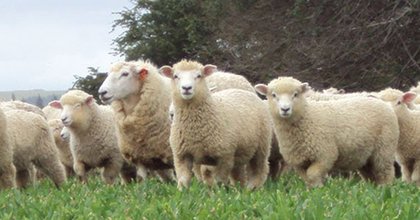
Included within a group of 3,000 predominantly Romney ewes are a trial group of 350 Wiltshire and Romneys.
The majority of the offspring are sold store the majority of these off mother in the 2nd week of December, the balance are finished on summer crop.
Numbers have varied on Riverside in recent years to accommodate the Wiltshire trial. Ewe hoggets are mated at various levels once again dependant on trials and feed conditions.
Production and future targets
| 2023/2024 | 2024/2025 | 2025/2026 | |
|---|---|---|---|
| Scanning | 202% | 205% | 185% |
| Ewe death | 4.95% | 4.86% | 4.1% |
| Lambing | 158% | 160% | 150% |
| Dry | 2.9% | 3.9% | 2.5% |
| Weaning weight | 28.6kg | 28.5kg* | 30kg |
Beef
Riverside’s beef policy centres on 2 age classes of steers to control the volatile summer production and if necessary act as a buffer mob.
Key strategies to improve cattle performance are as follows.
- Target winter growth rates of over 0.6kg/day for June and July with the use of crops.
- Kill over 60% of animals before the second winter.
Production and future targets
| 2023/2024 | 2024/2025 | 2025/26 | |
|---|---|---|---|
| Cattle deaths | 0.6% | 1.0% | 0.5% |
| Prime steer carcass weight | 321.1Kg | 312.8kg | 325kg |
Fertiliser
Fertiliser programmes are based on soil test results.
Soil tests are done biannually and show the following results.
| Year | pH | Olsen P | SO4 | K |
|---|---|---|---|---|
| 2010 | 5.6 | 25 | 11.4 | 8.3 |
| 2012 | 5.8 | 18 | 12 | 11 |
| 2016 | 5.6 | 16 | 13 | 8.3 |
| 2018 | 5.8 | 15 | 8 | 7.0 |
| 2020 | 5.5 | 13 | 10 | 7.0 |
| 2022 | 5.6 | 19 | 4.8 | 9.1 |
| 2024 | 5.9 | 17 | 6.8 | 7.5 |
2025 Fertiliser programme is as follows:
- Easy (Truck) Country: 250kg/ha Sulphur Super 15 (0-22-0-37)
- Hill (Plane) Country + Mikimiki: 200kg/ha Sulphur Super 15 (0-17-0-30)
- Lucerne: 400kg/ha 20% Potash Super (0-29-40-35)
Nitrogen fertiliser is also used strategically to boost lambing covers before set stocking on the multiple lambing areas.
Wintering stock numbers
Stock numbers as at 1 July 2025.
Sheep
| Stock | Numbers | Stock units |
|---|---|---|
| MAEwes | 1,760 | 1,760 |
| 2ths | 1,120 | 1,120 |
|
Trial Ewe Hoggets (mated) |
350 | 350 |
|
SIL Ewe Hoggets (SIL) |
850 | 595 |
| Rams | 50 | 40 |
|
Sheep Total |
4,130 | 3,865 |
Cattle
| Stock | Numbers | Stock units |
|---|---|---|
|
R2 Yr Steers + |
155 | 775 |
|
R1 Yr Steers |
119 | 476 |
|
Cattle Total |
274 | 1,251 |
Total stock units: 5,116
Our people
Riverside Farm is managed by Digby Lowe.

Research
A selection of research projects currently underway at Riverside Farm.
Breeding a self-shedding sheep
Steve Morris

A multiyear flock study is occurring at Riverside Farm recording production and performance as a flock is graded up from Romney to a Wiltshire flock.
The project will collect individual animal production – live weights, body condition score, reproductive data of ewes, mothering ability of ewes, growth rates of lambs, carcass and pelt traits, fleece weight and wool traits – welfare, and health data.
Modelling has indicated that in the long-term a change to a self-shedding flock will be profitable. But our model is limited by lack of objective data in regard to production data over the transition period.
Current assumptions are based on anecdotal industry data, or trial data from more than 20 years ago. The modelling suggests that the coarse wool greasy price would have to exceed $4.15/kg greasy to break even on the costs of shearing in many farming scenarios.
Commercial seed trial
A small seed trial involving a commercial seed company is also undertaken on Riverside Farm.
More information
For further information please email us at: agstation@massey.ac.nz.
Related content
Commercialisation
We turn innovative research into commercial opportunities through existing enterprises or new ventures.