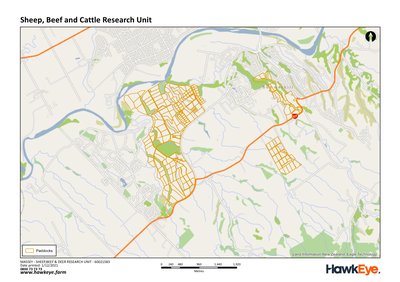
Three separate blocks make up this Massey farm – Dry Stock Unit, Haurongo farm and Keebles farm.
Objectives
- To provide a facility for quality research, teaching and extension in sheep and beef farming.
- To be managed as a profitable unit.
- To provide a link between the university and agribusiness.
Farm features
About the farm
A feature of the Sheep, Beef and Cattle Research Unit is Keebles Bush, a 15.5 hectare protected bush reserve considered to be 1 of the finest remaining examples of podocarp/broadleaf lowland forest in the Manawatū.
The Unit is made up of 3 separate blocks, subdivided into approximately 216 paddocks, ranging from 0.16 to 5.08 ha. Conventional post and batten fences are used plus some 7-wire electric.
Location & map
The Sheep, Beef and Cattle Research Unit is located approximately 7 km south east of Palmerston North on Tennent Drive SH 57.
Area
506.84 hectares
Effective Area: 421.67 hectares.
Altitude
Ranges from 40 to 80 metres above sea level.
Topography
Flat terrace dissected by easy gullies, with some steep faces.
Climate
1000mm is the average annual rainfall – July is the wettest month, February the driest month. Prevailing southwest winds.
Temperature
Soil temperature (at 10 cm): 6.7°C July minimum, 18.5°C January maximum.
Soils
- Free draining recent alluvial soil (Manawatū/Rangitikei) on river terraces.
- Poor draining heavy clay Tokomaru Silt Loam on the higher terraces.
- Compact clay loams with compact subsoil, poor natural drainage and with a tendency to dry out in summer. Moderate natural fertility.
- Some Ohakea Silt Loam soils.
- Haurongo Farm has predominantly Tokomaru Silt Loam.
Drainage
Tile and mole.
Water supply
The Keeble block is supplied by reticulated water from main Massey University supply. On Haurongo bore water is pumped to a central reservoir then gravity fed to paddocks.
Staff
2 full-time equivalent labour units and casual staff as required.
Stock policy
Sheep
All sheep on Keebles are involved in research trials so feeding and breeding policy is largely determined by trial protocols. Numbers on farm vary depending on research requirements but generally around 700 MA ewes are wintered and lambed down. No ewe hogget replacements are retained from the breeding ewes but on occasions ewe hoggets may be acquired for specific trials. Only Terminal sires are used, and replacement Mixed Age ewes are transferred in from Tuapaka Farm annually as replacements.
Beef
Policy is largely determined by research requirements. No capital beef stock is currently carried on Keebles – dairy beef steers or heifers are acquired from the 2 dairy farms and carried through to finishing before the second winter.
Dairy grazing
150-200 dairy replacements heifers (owned by University dairy farms) come on farm after being weaned from milk November/December. These are carried through on the SBCRU until several weeks before calving as 2-year-old heifers.
200 dry dairy cows from the University farms are also carried over the winter and are grazed on crop with silage that is grown on farm also.
Yards
Main set of covered yards attached to five-stand raised board woolshed (~700 sheep night-pen capacity). Another set of satellite yards are located towards the rear of the farm.
The main set of sheep yards are attached to the small woolshed (two-stand, night pen of 200).
There is a modern Te Pari set of cattleyards on Keebles.
Pasture
Pasture is predominantly perennial ryegrass and white clover species but boosted by chicory mixes.
Grazing policies
Non-trial mobs are generally rotationally grazed, with baleage used to extend the rotation when required. Cows and in-calf heifers graze a winter forage crop (primarily kale).
Regrassing policy
Pastures are renewed on a 10-year rotation.
Fertiliser
Fertiliser programmes are based on soil test results.
Soil tests are done biannually and show the following results:
Keebles Farm
| Year | pH | Olsen P | SO4 | K | Mg |
|---|---|---|---|---|---|
| 2002 | 5.9 | 26 | 4 | 6 | |
| 2004 | 5.6 | 19 | 13 | 5 | |
| 2010 | 5.8 | 29 | 10 | 7 | 24 |
| 2012 | 6.2 | 17 | 9 | 4 | 19 |
| 2016 | 5.8 | 28 | 12 | 6 | 22 |
| 2018 | 5.9 | 21 | 6 | 4 | 18 |
| 2020 | 5.6 | 28 | 9.5 | 5 | 23 |
| 2022 | 5.6 | 38 | 4.8 | 9.1 | 21 |
| 2024 | 6.1 | 42 | 6 | 10 | 25 |
Haurongo Farm
| Year | pH | Olsen P | SO4 | K | Mg |
|---|---|---|---|---|---|
| 2002 | 5.8 | 18 | 7 | 7 | |
| 2004 | 5.6 | 20 | 7.0 | 7 | |
| 2010 | 5.5 | 30 | 7.0 | 4 | 17 |
| 2012 | 5.9 | 25 | 13 | 6 | 17 |
| 2020 | 5.8 | 22 | 10 | 4 | 18 |
| 2022 | 6.0 | 30 | 6.2 | 6 | 18 |
| 2024 | 6.0 | 31 | 4.0 | 7 | 25 |
Maintenance fertiliser program 2025: 230 kg/ha of Sulphur Super with added Selenium (0-17-0-30).
Crops and supplements
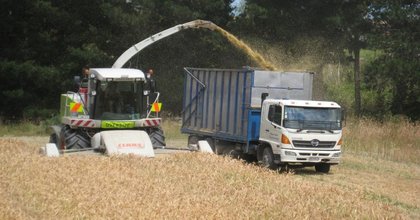
10ha kale plus 10ha chicory and are sown annually. Around 10ha of maize silage is harvested annually and transferred to Dairy 4. Baleage is harvested off approximately 25 ha, along with hay.
2025 wintering stock numbers
At 1 July 2025:
| Stock | Numbers | Stock units |
|---|---|---|
| MAEwes | 700 | 700 |
| Rams | 8 | 7 |
| Two tooths | ||
| Ewe hoggets | 260 | 180 |
| Total sheep | 968 | 887 |
Cattle
| Stock | Numbers | Stock units |
|---|---|---|
| R2 Year Charolais X Steers | 44 | 220 |
| R2 Year Charolais X Heifers | 37 | 167 |
| R1 Heifers | 162 | 668 |
| R1 M/S Dairy X | 58 | 232 |
| Autumn M/S FXH Calves | 45 | 180 |
| Dairy Cows Wintered | 200 | 308 |
| Cattle Total | 546 | 1775 |
Our people
The Sheep, Beef and Cattle Unit is managed by Steven Bayler.

Research
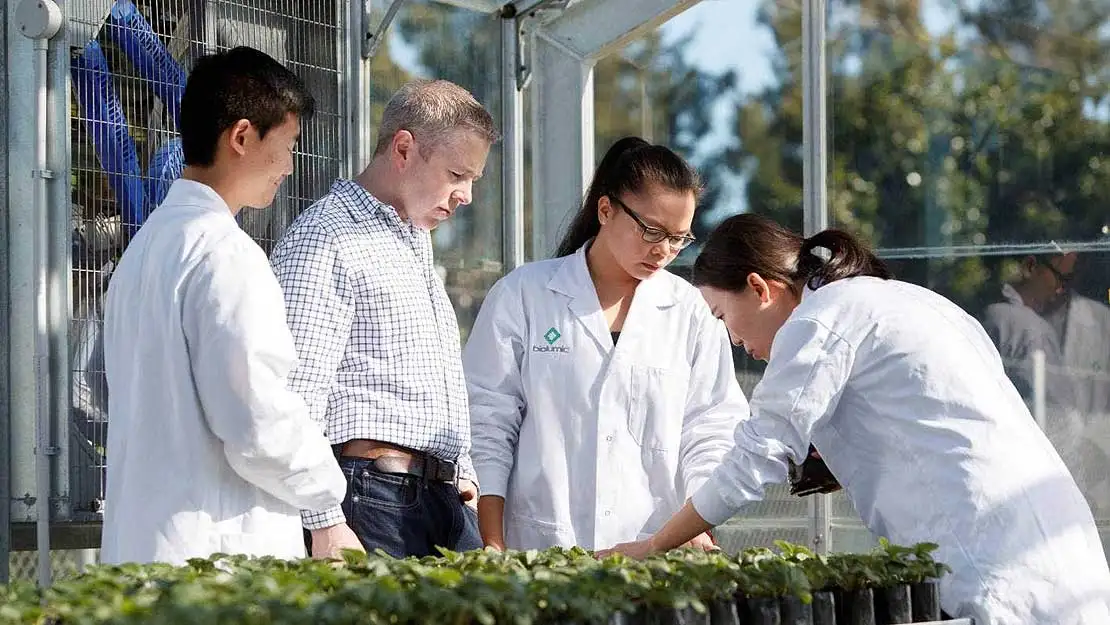
Keebles Farm has 1 research project.
Reducing the environmental footprint of sheep and beef farming
Lydia Cranston, Dave Horne, James Miller, Paul Kenyon
This project involves measuring nitrate leaching using hydrologically isolated plots under sheep and cattle grazing. Between 2019-2021, nitrate leaching was compared when breeding ewes grazed one of 4 forage types;
- ryegrass/white clover (control)
- ryegrass/white clover
- clover
- brassica ie. swedes/kale
Overall the results indicated very low levels of nitrate leaching compared to dairy cattle grazing with the exception of the winter brassica treatment where higher rates of nitrate leaching were observed. These results are currently being written up for publishing in a scientific journal.
In 2022, a new phase of the experiment is starting. The aim of this phase is to see if nitrate leaching observed when sheep graze a winter brassica can be reduced by sowing a comparison grass species to act as a catch crop. The second aim is to compare nitrate leaching under sheep and cattle grazing.
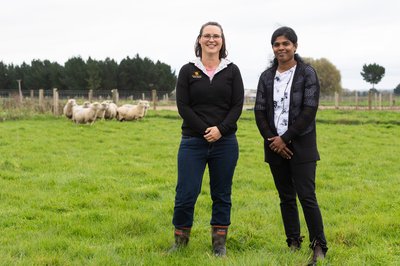
Project leader Dr Lydia Cranston and PhD student Sarmini Maheswaran.
History
Keebles was purchased in 1978 from the estate of Charles Keeble. Haurongo was originally part of a research farm run jointly by the now defunct Department of Scientific and Industrial Research (DSIR), and Ministry of Agriculture and Fisheries (MAF). Ownership was transferred to Massey University in 1987.
Read more about the history of Massey
More information
For further information please email us at: agstation@massey.ac.nz
Related content