- Where you can study
-
Manawatū campus (Palmerston North)
-
International students
International students are not New Zealand citizens or residents.
- Open to international students on campus in New Zealand
- Note:
- Note: Selected entry qualification.
Specialise in Air Transport Pilot for your Bachelor of Aviation at Massey
Massey University’s Bachelor of Aviation (Air Transport Pilot) is a university qualification for career pilots. You will not just train to be a professional pilot, but to become a ‘flight deck manager’ with a university education and an in-depth understanding of the aviation industry.
Turn your passion into a career
Massey is the only place in New Zealand where you can turn your passion for aviation into a university qualification. We are not only an internationally recognised pilot training facility but we also give you a broad knowledge of the global aviation industry.
We will also introduce you to the critical ‘soft’ skills required of a professional aviator such as:
- decision-making
- communication
- workload management
- conflict resolution.
State-of the art aircraft and equipment
You’ll learn to fly in our fleet of technically advanced Diamond single engine and twin engine aircraft equipped with full digital avionics. We also have a state-of-the-art flight Diamond DA-42 flight simulator. Its 220-degree wraparound screen can match any airport in the world. Massey University was the first pilot training facility in New Zealand to install this new-generation simulator.
Electronic flight bags
Electronic flight bags (EFBs) are now almost standard for every major international air carrier. As a new Bachelor of Aviation (ATP) student, you will be issued with an Apple iPad to be used as your EFB during your flight training.
A Bachelor of Aviation in Air Transport Pilot is a good fit if you:
- have well-developed leadership qualities
- enjoy mathematics and physics
- want a degree - not just a ‘licence to fly’.
Planning information
Planning information
All Bachelor of Aviation students undertake a full-time qualification. In your first year you will take twelve 15-credit courses, making a total of 180 credits.
All your courses in Year One and Year Two are compulsory.
Meeting requirements for industry membership
Becoming a pilot
To become a pilot you will need to complete this qualification, comprising a total of 480 credits as outlined on this page.
At the completion of 360 credits in this qualification, you will have met the requirements for the award of a New Zealand Commercial Pilot Licence (CPL) with Multi-Engine and Instrument Rating, plus hold credits for all New Zealand Air Transport Pilot Licence (ATPL) Theory examinations.
To gain your full APTL, you will also need to complete practical experience as outlined on the aviation.govt.nz website.
Official regulations
To understand what you need to study and must complete to graduate read the official rules and regulations for this qualification.
You should read these together with all other relevant Statutes and Regulations of the University including the General Regulations for Undergraduate Degrees, Undergraduate Diplomas, Undergraduate Certificates, Graduate Diplomas and Graduate Certificates.
Returning students
For returning students, there may be changes to the majors and minors available and the courses you need to take. You can go to the section called ‘Transitional Provisions’ in the Regulations to find out more.
In some cases the qualification or specialisation you enrolled in may be no longer be taking new enrolments, so may not appear on these web pages. To find information on the regulations for these qualifications go to the Massey University Calendar.
Please contact us through the Get advice button on this page if you have any questions.
Courses you can enrol in
Courses you can enrol in
Part One
Course code: 190104 Principles of Navigation I 15 credits
An introduction to navigational principles and operational requirements for visual flight.
View full course detailsCourse code: 190107 Human Performance 15 credits
The application of information processing strategies for improving performance in learning, problem-solving, decision-making, interpersonal interrelations, and an introduction to aviation medicine.
View full course detailsCourse code: 190112 Introduction to Flying 15 credits
This course is an introduction to the theory and practice of flight radio, aviation law and principles of flight for pilots.
View full course detailsCourse code: 190113 Aviation Meteorology 1 15 credits
An introduction to aviation meteorology for pilots.
View full course detailsCourse code: 190114 Aircraft Systems 1 15 credits
An Introduction to aircraft systems for pilots
View full course detailsPart Two
Course code: 190120 Aeronautical Legislation 15 credits
This course includes the integration of theory and practice for aviation regulations and law pertaining to Visual Flight Rules (VFR) and Instrument Flight Rules (IFR).
View full course detailsCourse code: 190123 Aircraft Systems 2 15 credits
A study of aircraft systems for light aircraft and their performance management.
View full course detailsCourse code: 190124 Aircraft Performance 15 credits
The study of aircraft performance management for single-engine aircraft, including propeller theory, and operational performance requirements.
View full course detailsCourse code: 190154 Principles of Navigation II 15 credits
An in-depth study of Air Navigation principles; and the construction, properties and usage of aeronautical charts.
View full course detailsPart Three
Course code: 190201 Aircraft Systems 3 15 credits
This course is an examination of advanced multi-engine aircraft systems, including structures of heavy aircraft.
View full course detailsCourse code: 190203 Air Traffic Control/Aviation Law 15 credits
The integration of theory and practice for Flight Operations and Flight Standards. This course will enable pilots to use the operational procedures and facilities required by civil aviation and air traffic control organisations. Students will be introduced to international aviation systems, including the Covenants of the International Civil Aviation Organisation (ICAO).
View full course detailsCourse code: 190204 Flight Planning and Advanced Navigation (Part 1) 15 credits
First of two courses on the development of practical flight planning competencies including route planning, fuel planning, load planning and flight plan amending for instrument flight operations. The use of inflight navigation techniques, instrument flight management, and search are included.
View full course detailsCourse code: 190205 Crew Resource Management 15 credits
The development of practical competencies in crew resource management (CRM) in the professional aviation environment.
View full course detailsCourse code: 190206 Aerodynamics 1 15 credits
This course introduces principles of incompressible fluid statics and fluid dynamics, basic concepts of low and high speed aerodynamics, and lift theory.
View full course detailsPart Four
Course code: 190221 Climatology 15 credits
A study of the global climate and of regional climates at the levels at which modern jet aircraft fly and at lower levels..
View full course detailsCourse code: 190237 Heavy Jet Aircraft Performance 15 credits
This course introduces performance theory as it applies to modern heavy jet aircraft. This course covers NZ ATPL performance theory requirements.
View full course detailsCourse code: 190254 Flight Planning and Advanced Navigation (Part 2) 15 credits
Second of two courses on the development of practical flight planning competencies, including route planning, fuel planning, load planning and flight plan amending for instrument flight operations, and for long distance heavy transport operations for B777 aircraft.
View full course detailsCourse code: 190351 Aircraft Systems 4 15 credits
An in depth study of mechanical aircraft systems, as they apply to large aircraft.
View full course detailsCourse code: 190356 Aerodynamics 2 15 credits
This course introduces principles of stability and control of aircraft, high speed aerodynamics, and methods for analysing aerodynamic properties of high speed aircraft.
View full course detailsAir Transport Pilot Subject Courses
Course code: 190121 Aviation Meteorology 2 15 credits
An examination of fundamental concepts and processes in meteorology and climate.
View full course detailsCourse code: 190164 Aeroscience 15 credits
This course is an examination of the principles of mathematics, mechanics, and physic as they apply to aeroscience.
View full course detailsAviation Management Subject Courses
Course code: 190116 Introduction to Management in Aviation 15 credits
An overview of management concepts in the aviation industry.
View full course detailsCourse code: 190220 Managing Airline Systems 15 credits
An examination of the management of airline organisations.
View full course detailsCourse code: 190308 Airport Operational Management 15 credits
An examination of the management of airport systems, such as air-side and land-side facilities, technical and support services which contribute to the operational effectiveness of modern airports. The course will further examine the relationship between airport authorities and the local community.
View full course detailsCourse code: 190313 Advanced Aviation Human Factors 15 credits
This course explores the role of human behaviour and physiological limitations in aviation, how they fit with complex systems, and how behaviour and systems may be modified to improve safety.
View full course detailsCourse code: 190314 Legal Issues in Aviation 15 credits
General principles of law as applied in the context of the airline transport industry. The course will focus on the application of law to flight crew, airline operations and civil aviation authorities in terms of both international conventions and treaties and of national legislation and law. Issues such as contractual and tortious liability will be considered.
View full course detailsCourse code: 190327 Managing Cultures in Aviation 15 credits
A critical evaluation of theory and practice of management of cultures in aviation, incorporating: (a) an exploration of theoretical and practical aspects of cultural diversity and its effect on aviation industry in the global business environment; and (b) an assessment and management of international, national, and organisational cultural dimensions and their shaping influence in various aspects of aviation operation.
View full course detailsCourse code: 190340 Contemporary Issues in Aviation Security 15 credits
This course explores aviation security with a particular emphasis on terrorism. Students explore key incidents, areas at risk, and the legislation and practical means by which risks are managed. The trade off between an erosion of civil liberties and increased security will be explored, as will the reasons why risks will always remain.
View full course detailsBachelor of Aviation Options
Option One: Flight Instruction (Aeroplane)
Course code: 190282 Introduction to Flight Instruction 15 credits
A theoretical and practicum-based study of flight instructional and teaching skills required for employment as Flight Instructor.
View full course detailsCourse code: 190285 Aerobatic Aircraft Handling 15 credits
The theory and practice of advanced aircraft handling techniques, aerobatics and advanced stalling and spinning.
View full course detailsCourse code: 190288 Advanced Aircraft Handling 30 credits
This course covers the theory and practice of aircraft operations to an advanced level. The course’s emphasis is on the development of non-technical skills applicable to a pilot working in a multi-crew environment. The student will be introduced to safety management systems (SMS) and optimal decision making under normal, abnormal, and emergency phases of flight. The course bridges the gap between traditional General Aviation Operations and Air Transport Operations.
View full course detailsCourse code: 190301 Flight Instructor Human Factors 15 credits
Theory and application of human factor issues in decision-making, interpersonal relations, communication styles and personality characteristics as they affect flight deck performance in the instructional environment.
View full course detailsCourse code: 190315 Flight Instruction Fundamentals I 15 credits
Principles and techniques for theory, simulator and flight instruction for primary visual flight and day operations, including a review of aircraft performance management requirements. The course will incorporate the theoretical issues which underpin aviation science and aircraft systems.
View full course detailsCourse code: 190335 Flight Instruction 30 credits
This integrated course includes the principles and techniques for theory, simulator and flight instruction.
View full course detailsOption Two Aviation: Business Management
120 credits of elective courses as approved by the Chief Executive Officer.
At least 60 credits including 190.288 must be selected from the 190 prefix Aviation and up to 60 credits may be selected from the following prefixes:
110 (Accountancy), 114 (Human Resource Management), 115 (Business), 125 (Finance), 152 (Management), 153 (Dispute Resolution), 155 (Business Law), 156 (Marketing), 157 (Information Systems), 178 (Economics), 219 (Business Communication), 295 (Business).
At least 30 credits must be at 300 level.
Entry requirements
Entry requirements
Admission to Massey
All students must meet university entrance requirements to be admitted to the University.
Specific requirements
This is a selected entry qualification. This means there are a number of extra requirements you must meet.
To enter the Bachelor of Aviation, you must pass NCEA Level 3/Year 13 or equivalent in an ‘English-rich’ subject in order to demonstrate your ability to write a formal extended essay. These include 1 of the following:
- classical studies
- English
- geography
- history
- history of art
- media studies
- religious education (RE)
- business studies
- biology
- economics.
We highly recommend that you have passed Mathematics (Calculus) and Physics at NCEA Level 3/Year 13 or equivalent.
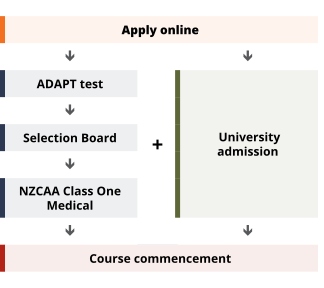
When you first apply online you need to:
- provide a CV including academic and work history
- have completed a trial flight
- provide any information of circumstances in your past personal or professional life that might make you ineligible to train for, or hold, a professional pilots licence in New Zealand (see below for more information).
If you already have a NZCAA Class One Medical Certificate please also upload a copy with your application. But this is not essential for your initial application.
There are 2 more stages to the application process:
Stage 1
You will take and pass an online ‘ADAPT’ test. See below for information.
Before Stage 2
Before you will be considered by selection board in Stage 2, you will have:
- taken at least 1 trial (experience) flight
- pre-booked your medical appointments (with both a CAANZ approved medical examiner and optometrist).
Note: you must allow enough time to undertake all the medical and vision assessments required for a NZCAA Class One Medical Certificate so that you will have been issued this certificate no later than 1 week prior to your course commencement.
Stage 2
Your application will be assessed, and you may then be invited to the ‘selection board’. This involves:
- taking part in a panel interview
- passing pilot aptitude assessments - including a flight simulator aptitude test, psychometric and physics tests
- completing 2 writing tasks: English language competency tests (an essay and a vocabulary test) and a multi-choice / short answer mathematics assessment.
- completing a 'Fit and Proper Person' declaration that you know of no barrier to being issued a 'Fit and Proper Person' (F&P) clearance by the CAANZ.
Before you start
Once you are successful in gaining a place in the Bachelor of Aviation qualification you will also need to complete further tasks. These include:
- providing evidence of holding a current CAANZ Class One Medical Certificate,
- providing evidence of meeting the University’s academic and English Language regulations (international students )
Selection Board
Selection boards are held twice each year:
- Beginning of October (and December, if required) for a Semester One start
- Late May/early June for a Semester Two start.
Once you apply for this qualification you will be advised of the exact date of your selection board appointment.
CAANZ Class One Medical Certificate
You must obtain a CAANZ Class One Medical Certificate before being confirmed into the Bachelor of Aviation. If you do not already hold a current Class One Medical Certificate you must arrange to book your medical appointments with both a CAANZ - approved medical examiner and optometrist, allowing enough time to complete same before your degree commences.
If you have a CAANZ Class One Medical Certificate please upload a copy with your application.
Application closing date
Applications for a Semester One start close on 1 November for domestic students and 1 October for international students, for study commencing the following year.
Applications for a Semester Two start close on 1 May for domestic students and 1 April for international students, in the year of study.
English language requirements
To study this qualification you must meet Massey University's English language standards. Where English is not your first language, you must have achieved an Academic IELTS of 6.5 with no band below 6.0, or equivalent.
English language skills
If you need help with your English language skills before you start university, see our English for Academic Purposes (EAP) courses.
Fees and scholarships
Fees and scholarships
2026 tuition fees
- Domestic students: $63,369
- International students: $114,341
Tuition fees are estimates only. The exact fees charged will depend on which courses you select at the time of enrolment. The estimates are for full-time study (120 credits). Fees are in New Zealand dollars and include Goods and Services Tax (GST).
The estimates do not include the Student Services Fee. This fee is $1,164 for on-campus students and $948 for distance students for full-time study (120 credits). For more information about this fee and other fees you may need to pay, see non-tuition fees.
There may also be charges for things such as study resources, software, trips and contact workshops.
Course fees
You can view fees for the courses that make up your qualification on the course details pages.
Student loans (StudyLink) and Fees Free scheme
You may be eligible for a student loan to help towards paying your fees.
The New Zealand Government offers fees-free tertiary study for eligible domestic students. Find out more about the scheme, including how much could be covered and your eligibility on the Inland Revenue website.
Careers and job opportunities
Careers and job opportunities
A career as a pilot is exciting and highly sought-after.
The Bachelor of Aviation (Air Transport Pilot) opens up opportunities to become airline pilots or any other potential career within the aviation industry.
Many graduates work as flight instructors in New Zealand or Australia, enabling them to build on their instructional techniques expertise which is a valuable skill for those who eventually decide to take up a role as an Airline Training Captain.
You may wish to progress to key management or training positions for an airline or with international bodies such as the International Air Transport Association (IATA) or the International Civil Aviation Organisation (ICAO). Postgraduate study in aviation would be worth considering if you intend to follow this path.
International students
International students
New Zealand is a great place to study. Massey University’s reputation is supported by our international rankings, accreditations and associations. We are rated five star plus by the QS World University Rankings.
Massey University has small class sizes, and our lecturers and staff are friendly and approachable.
As an international student, there are entry requirements that will apply to you. We recommend that you apply at least three months before your anticipated start date so your application can be processed in time. There are additional steps you will need to take. These include obtaining a visa and travel bookings as your study will be in New Zealand.
Related study options
Aviation Studies – Graduate Diploma in Aviation
Take your aviation career to the next level with Massey's Graduate Diploma in Aviation. Gain a university qualification while following your passion for aviation.
Flight Instruction – Graduate Diploma in Aviation
Add a new dimension to your commercial pilot’s licence. Gain a university qualification while following your passion for aviation.
Master of Aviation – MAv
Enhance your career prospects in the internationally competitive aviation sector with the Master of Aviation. Massey is the only place in New Zealand where you can turn your passion for aviation into a tertiary qualification.
Related content