
Massey University
Like all universities, Massey is a complex organisation. We have:
- more than 25,000 students from over 120 countries
- 3,000+ academic and professional staff
- 5 colleges
- 23 academic schools
- 200+ qualifications
- 20 professional services departments.
To make sure the university operates smoothly we have management systems in place, undertaken by an extensive staff.
People and roles
We have a University Council and Executive Leadership Team, responsible for leading Massey strategically and operationally.
Academic teaching, research and professional staff work throughout the university and are crucial to our success and reputation.
Chancellor – University Council
The Council elects the Chair, known as the university Chancellor from among its members. The Chancellor provides leadership in developing an effective governance culture and makes sure there are strong communication flows between the Council and management.
The Chancellor role involves corporate chairmanship with some ceremonial requirements. The appointee is often chosen for their strong corporate governance and leadership experience.
Pro-Chancellor – University Council
The Pro-Chancellor acts as the deputy to the Chancellor, and takes on other specific roles as assigned by the Chancellor or the wider Council.
Vice-Chancellor – Executive Leadership Team
The Vice-Chancellor is the chief executive of the university, who leads and directs its strategy and overall operations.
The Vice-Chancellor also:
- chairs the University Executive Leadership Team
- sits on the University Council
- is responsible for securing sufficient funding
- represents the University externally.
Executive Leadership Team
Deputy Vice-Chancellor Academic
The Deputy Vice-Chancellor Academic oversees Massey’s 5 Colleges, as well as the other areas of the university which focus on teaching and learning. Their portfolio also encompasses services which support students with their academic endeavours, such as the Student Registry and libraries.
Deputy Vice-Chancellor Research and Enterprise
Responsible for leading Massey’s research and enterprise operations, and ongoing relationships with alumni and the Massey University Foundation. They also oversee the Riddet Institute, NZ Food Safety Science Research Centre and Massey University Press.
Deputy Vice-Chancellor Māori
The Deputy Vice-Chancellor Māori is a key role that supports the university to honour te Tiriti o Waitangi (the Treaty of Waitangi is one of New Zealand’s founding documents), and in all areas of te ao Māori. This role oversees our relationships with local mana whenua, iwi and hapū, and has close links with Māori staff and students.
Te Tiriti o Waitangi at Massey
Deputy Vice-Chancellor Students and Growth
The Deputy Vice-Chancellor Students and Growth is responsible for the recruitment of students, the overall student experience, Māori and Pacific student success and global engagement.
Chief of Staff
The Chief of Staff provides strategic leadership of the university's governance, strategy, risk and assurance functions, ensuring the frameworks, processes and organisational disciplines that support the successful delivery of the university's strategic ambitions are effective, aligned and future-focused.
Chief Operating Officer
The Chief Operating Officer provides strategic leadership of the university’s financial enterprise, investment strategy and operational foundations, ensuring resources, capital and assets are strategically deployed to enable the successful delivery of Massey's strategic ambitions.
Chief People and Culture Officer
The Chief People and Culture Officer is accountable for providing strategic leadership for the university's people, culture and organisational capability agenda, ensuring Massey has the workforce, leadership capability, culture and wellbeing foundations required to achieve its academic, research and organisational ambitions.
Chief Information Officer
The Chief Information Officer is responsible for leading Massey's technology strategy, ensuring that information systems, digital services, cybersecurity and data management support the university's goals and operational needs.
Pro Vice-Chancellors
The Pro Vice-Chancellor (PVC) leads each of our 5 academic colleges:
Colleges manage the day to day running with PVCs overseeing academic and research direction. PVCs often have a significant academic reputation on top of the responsibility of managing a substantial business unit of the university.
Governance and management
The university has a structure made up of a formal governance council, a deliberative board, and an executive team.
The University Council – governance
The University Council is charged with:
- determining the educational character and mission of the university
- overseeing its activities
- monitoring effective and efficient use of resources
- safeguarding the solvency and assets of the university
- approving annual estimates of income and expenditure.
The Council is also responsible for appointing the Vice-Chancellor.
University Council structure
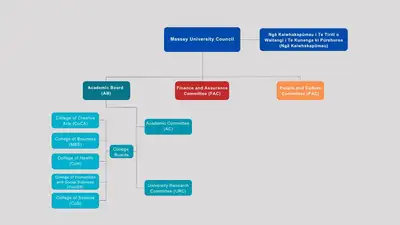
The Academic Board – deliberative
The Education and Training Act 2020 requires Massey University Council (Council) to establish an academic committee consisting of the Vice-Chancellor, and members of the staff and students to:
(a) Advise the Council on matters relating to courses of study or training, awards, and other academic matters
(b) Exercise powers delegated to it by the Council.
The academic committee of Massey University Council is known as the Academic Board and is a sub-committee of the Council.
More on University Board and committees
Academic Board structure
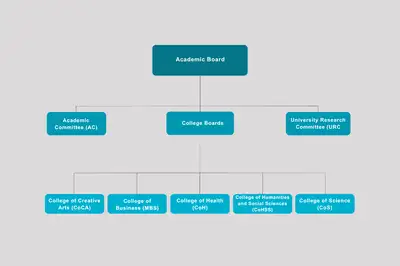
The Executive Leadership Team
The Executive Leadership Team is the senior management group of the university, with a range of responsibilities relating to executing strategy and overseeing operations. It also advises the Vice-Chancellor and University Council on management and other matters, where appropriate.
Organisational structure
The university is made up of 5 academic colleges and 20 professional services.
Governance structure
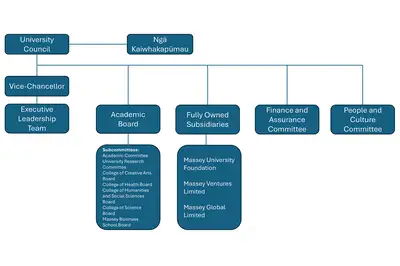
Massey University governance structure
How we are funded
Massey University receives funding from a variety of sources. In 2022, our main funding sources were as shown here.
| Funding source | Approximate percentage of funding |
|---|---|
| Government grants | 37.4% |
| Student fees | 29.1% |
| Charges for services | 26.4% |
| Trust funds | 1.7% |
| Interest | 0.3% |
| Other losses/gains | 5.1% |
The university then spent this funding on expenses as shown here.
| Expense | Approximate percentage of spending |
|---|---|
| Staffing | 55.1% |
| Other direct costs (including consumables, scholarships, repairs and maintenance, computing, contracted services, travel and accommodation) | 29.1% |
| Depreciation and amortisation | 13.9% |
| Trust funds | 1.9% |
The university is a public institution and so we are not permitted to make any profits. However, we are required by the Tertiary Education Commission to make a 3% surplus annually in order to maintain financial stability and invest in future activities. Without this surplus, we wouldn’t be able to do a lot of the things we are doing now.
Contacts

Governance Advisor
Governance and Assurance team
Contact the Governance and Assurance office for governance enquiries or more information about Council and Committee meetings.
Tania Kennedy
Please contact Tania at the Office of the Vice-Chancellor for Executive Leadership Team and management enquiries.
Related content
Pūrehuroatanga
Collaborating to drive diversity, access, equity and excellence.
Strategy & policy
Read key te Tiriti o Waitangi elements in the Massey University Strategy and our Te Tiriti commitments in our Tiriti o Waitangi policy.
Policies, procedures & guidelines
This page lists Massey's policies, procedures and guidelines.
Massey News
Stay up to date with the latest Massey University news and articles – from research findings to student activities.