Qualification name change
The Bachelor of Horticultural and Plant Systems was previously called the 'Bachelor of Horticultural Science'. The updated qualification has two majors you can choose between.
- Type of qualification
- Bachelor's degree
- Level of study
-
Undergraduate study
An undergraduate qualification is usually the first one you study.
NZQF level 7Our courses follow the New Zealand Qualification Framework (NZQF) levels.
- Time to complete
-
3 years full-time (360 credits)Part-time available
-
International students
International students are not New Zealand citizens or residents.
- Open to international students on campus in New Zealand
- Note:
- Note: Some distance courses require attendance at contact workshops.
Study a Bachelor of Horticultural and Plant Systems – BHort&PlantSys
Want to get hands-on experience with plants? From natural to managed environments, this degree has you covered.
Plants are central to Aotearoa New Zealand’s economy, ecosystems and cultural identity. This qualification explores how plants function as complex, dynamic systems. It also explores how they shape food production systems and natural landscapes to meet environmental and economic goals.
The Bachelor of Horticultural and Plant Systems prepares you to tackle some of today’s most pressing global and local challenges:
- food security
- climate change
- biodiversity loss
- sustainable land use.
By promoting sustainable horticulture, responsible resource management and resilient ecosystems, this qualification directly aligns with several UN Sustainable Development Goals to foster a healthier planet and communities.
This qualification has 2 majors – Horticultural Production and Integrative Plant Biology. You can tailor your studies toward applied growing systems, advanced plant science and all points in between. You’ll gain real-world experience in the lab, field and industry, supported by expert researchers and educators.
Graduates are job-ready for careers in horticulture, plant breeding, lab-based research, environmental biology and other plant-based industries. Wherever your plant interests lead, this qualification provides the tools you need.
Further study
This qualification is also useful if you are considering postgraduate study. Graduates will gain the knowledge and skills necessary for more advanced studies in plant breeding. Graduates could also consider further study in Horticulture, Plant Science, Ecology and Conservation or the wider Biological Sciences.
A BHort&PlantSys is a good fit if you:
- are curious about how plants shape our environment, food production systems and economies
- want to drive innovation in sustainable horticultural production, biodiversity conservation and climate resilience
- are seeking hands-on experience and pathways into horticulture, research, policy or the plant-based industries of the future.
Entry requirements
Entry requirements
Admission to Massey
All students must meet university entrance requirements to be admitted to the University.
Specific requirements
There are no specific entry requirements for this qualification, outside of university admission regulations.
English language requirements
If English is not your first language and your qualifying entry qualification was not taught in English, you must have achieved an IELTS 6.5 with no band below 6.0.
General information about English language requirements:
Prior learning, credit and exemptions
For information on prior learning, exemptions and transfer of credit or other questions:
- review the Recognition of Prior Learning regulations
- contact us through the Get advice button on this page.
English language skills
If you need help with your English language skills before you start university, see our English for Academic Purposes (EAP) courses.
Recommended prior learning
To be successful in your studies we recommend you have credits at NCEA Level 3 (or equivalent) in some of the following subjects:
- agriculture or horticulture
- biology or science
- statistics.
These subjects will help ensure that your transition to university study is as smooth as possible.
Official regulations
To understand what you need to study and must complete to graduate read the official rules and regulations for this qualification.
You should read these together with all other relevant Statutes and Regulations of the University including the General Regulations for Undergraduate Degrees, Undergraduate Diplomas, Undergraduate Certificates, Graduate Diplomas and Graduate Certificates.
Returning students
For returning students, there may be changes to the majors and minors available and the courses you need to take. Go to the section called ‘Transitional Provisions’ in the Regulations to find out more.
In some cases the qualification or specialisation you enrolled in may no longer be taking new enrolments, so may not appear on these web pages. To find information on the regulations for these qualifications go to the Massey University Calendar.
Please contact us through the Get advice button on this page if you have any questions.
Structure of the Bachelor of Horticultural and Plant Systems
Structure of the Bachelor of Horticultural and Plant Systems
If you study full-time, in your first year, you’ll take eight 15-credit courses, making a total of 120 credits.
If you wish to study over 2 semesters, you should aim for 60 credits per semester. You may be able to take some courses at summer school. Make sure you include courses that are prerequisites for the next level of courses you wish to study.
As part of this qualification, you’ll complete 26 weeks of full-time work in horticulture during your study. This is usually done during the summer. There is full support to help you find practical work and have an enjoyable experience where you are learning while working. You'll also provide a report on your activities.
Typical pattern for the Bachelor of Horticultural and Plant Systems
Core courses These courses are a compulsory part of your qualification.
Major courses Choose from a selection of courses appropriate for your specialisation.
Elective courses Follow your interests. Your qualification may have selection guidelines for elective courses.
| Year One |
|---|
| Core course |
| Core course |
| Core course |
| Core course |
| Core course |
| Major course |
| Major course |
| IPB: major course HortProd major: elective |
| Practicum (0 credits) |
| Year Two |
|---|
| Core course |
| Core course |
| Major course |
| Major course |
| Major course |
| Major course |
| Major course |
| Major course |
| Practicum (0 credits) |
| Year Three |
|---|
| Core course |
| Major course |
| Major course |
| Major course |
| Major course |
| Major course |
| Major course |
| IPB: elective HortProd: major course |
Courses are each worth 15 credits, unless otherwise specified.
Courses and specialisations
Courses and specialisations
Credit summary
Each course is worth a number of credits. You combine courses (credits) to meet the total number of credits needed for your qualification.
360 credits
- Core courses – 120 credits
- Major courses – 180 credits
- Electives – 60 credits
- 26 weeks of practical work experience
Ensure that overall, you have:
- Not more than 165 credits at 100 level
- At least 75 credits at 300 level
Schedule A: Core courses (Choose 120 credits from)
Course code: 119120 Plants for Agriculture and Horticulture 15 credits
An introduction to the agricultural and horticultural species important to New Zealand's economy. Growth and development of agricultural and horticultural plants; their responses to the environment and management, and implications for production. Identification and biology of agricultural and horticultural plants, including weeds, pests and pathogens important to plant production.
View full course detailsCourse code: 119150 Practicum I 0 credits
Industry experience for at least ten consecutive weeks in a public or private business related to the land-based industries. A descriptive report demonstrating satisfactory observational, analytical and reporting skills is required.
View full course detailsCourse code: 119250 Practicum II 0 credits
Industry experience for at least ten consecutive weeks in a public or private business related to the land-based industries. A detailed, investigative report identifying and analysing opportunities, problems, policies and technical and research issues is required.
View full course detailsCourse code: 120101 Plant Biology 15 credits
This course is an integrated introductory study of plants. Major themes include: plant form and function (anatomy, morphology, photosynthesis, respiration, transport systems, mineral nutrition); regulation of growth and development, especially in response to the environment; plant diversity (systematics, evolution, life cycles, New Zealand flora); and plants and people (crop domestication, plant breeding and production, Māori plant use).
View full course detailsCourse code: 120219 Plants and People 15 credits
Plants as sources of food and beverage, medicine, fibres and dyes, with emphasis on their origin, domestication and the role of plant breeding to improve plants for human use. The physiological effects of active plant compounds on the body. The cultural and geographic origins of commercially important plants.
View full course detailsCourse code: 161140 Agricultural and Horticultural Statistics 15 credits
An introduction to statistics in an agricultural and horticultural context, including the presentation, analysis and interpretation of quantitative data.
View full course detailsCourse code: 189151 Principles of Soil Science 15 credits
An integrated introductory course in soil science. An exploration of the interaction between soil and the environment, soil formation and morphology, soil physical, chemical, and biological properties and their influence on soil management, nutrient cycling, and soil-plant interactions.
View full course detailsCourse code: 247111 Science and Sustainability for Agriculture and Horticulture 15 credits
The pursuit of environmental sustainability is a complex societal issue. This is a problem-based course, where students will develop their critical thinking, communication and information literacy and management skills as they evaluate interdisciplinary approaches to the contemporary sustainability challenge of climate action. Students will explore the intersection of science and community through exemplars of partnership between research and Te Ao Māori (the Māori world) in the context of primary production in Aotearoa New Zealand.
View full course detailsCourse code: 284210 Principles of Horticultural Production Systems 15 credits
The course provides a balanced overview of the major production systems and practices of modern commercial horticulture through both theoretical learning and hands-on experience. Students will explore in depth the fundamental principles and innovative practices and technologies involved in the production of horticultural crops, including plant propagation, crop establishment and management. Emphasis will be given to the relationship between horticulture and the environment and the integration of sustainable production practices.
View full course detailsCourse code: 284301 Horticultural Crop Development & Yield 15 credits
Physiological and applied aspects of monitoring, predicting and manipulating crop growth and development in production horticulture in order to optimize yield, quality and timeliness. Prediction of crop growth and development in response to changes in the environment and the associated decisions made by growers.
View full course detailsSchedule B: Majors
Some qualifications let you choose what subject you'd like to specialise in. Your major or endorsement is what you will take the majority of your courses in.
The Bachelor of Horticultural & Plant Systems qualification has 2 majors. Both majors will be required to propel New Zealand’s plant-based industries forward. Whatever you interest in the horticulture industry, we have a qualification to suit you.
Horticultural Production
This major is great for students who want to grow and manage fruit, vegetables and ornamental crops. It focuses on the theory and practice of horticulture, from soil and climate to harvest and innovation.
Integrative Plant Biology
For students driven by curiosity about how plants work and how we put plants to work, this major integrates plant biology, genetics and ecology – ideal preparation for future careers in horticulture, conservation and plant breeding.
Other relevant qualifications
If you are more interested in the management of the horticulture sector, please consider the Horticultural Management major in the BAgribusiness qualification.
This qualification also provides a strong foundation for postgraduate study. Graduates will be well-prepared for advanced studies in plant breeding, as well as further study in horticulture, plant science, ecology and conservation, or the broader biological sciences.
Horticultural Production
Do you have a passion for plants and people? Join one of the country’s largest economic sectors and gain skills for managing various crop production systems including orchards, open-fields and controlled environments.
Integrative Plant Biology
Where plant biology meets real-world impact – hands-on, job-ready, future-focused.
Fees and scholarships
Fees and scholarships
2026 tuition fees
- Domestic students: $7,614
- International students: $34,220
Tuition fees are estimates only. The exact fees charged will depend on which courses you select at the time of enrolment. The estimates are for full-time study (120 credits). Fees are in New Zealand dollars and include Goods and Services Tax (GST).
The estimates do not include the Student Services Fee. This fee is $1,164 for on-campus students and $948 for distance students for full-time study (120 credits). For more information about this fee and other fees you may need to pay, see non-tuition fees.
There may also be charges for things such as study resources, software, trips and contact workshops.
Course fees
You can view fees for the courses that make up your qualification on the course details pages.
Student loans (StudyLink) and Fees Free scheme
You may be eligible for a student loan to help towards paying your fees.
The New Zealand Government offers fees-free tertiary study for eligible domestic students. Find out more about the scheme, including how much could be covered and your eligibility on the Inland Revenue website.
Scholarships and awards
- Andrew Turnbull Scholarship
- Ann Sinclair Charitable Trust
- David Levene Foundation Bursaries
- Demetrians Agricultural Bursary
- He Oha Puiaki - Massey University Māori First Year Scholarship
- Horticulture NZ Undergraduate Scholarships
- John Perrin Scholarship
- J. S. Yeates Memorial Scholarship
- Ken and Elizabeth Powell Scholarship
- Massey University Undergraduate First Year Scholarship – School Leavers
- McEwan Pacific Student Scholarship
- New to Massey University First Year Student Agriculture and Horticulture Scholarship
- Noeleen Olson Undergraduate Horticultural Scholarship
- Pacific Science and Technology Scholarships
- Professor Ren Jizhou Scholarship
- Punchbowl Undergraduate Scholarship
- Sydney Campbell Foundation New to Massey University First-Year Undergraduate Scholarship
- Sydney Campbell Foundation Undergraduate Scholarship
- Toroa International Undergraduate Fee Scholarships - Semester 2, July 2026
- Waitawhiti Memorial Undergraduate Scholarship
- Zespri Horticultural Scholarship
Careers and job opportunities
Careers and job opportunities
Our graduates pursue careers both nationally and internationally, applying their expertise in horticulture and plant science to a wide range of professional contexts. Graduates will be well prepared to address global challenges in food production, biodiversity, sustainability and plant-based innovation. They can bring their skills to industries from commercial horticulture to environmental management and fundamental scientific research.
A career with variety
Some examples of careers that could lead on from this qualification include:
- plant breeder
- horticulturalist
- horticulture science consultant
- orchard and greenhouse production manager
- crop disease and pest control agent
- field biologist
- botanist
- lab technician
- forestry scientist
- ecological consultant
- horticulture technology and innovation specialist
- post-harvest manager
- biosecurity agent
- agronomist
- organic production specialist
- policy, regulation and advocacy specialist
- educator.
What our students say
“My degree has been crucial, allowing a smooth transition into the first year of my career. It set me up with subjects like the soil science, GIS mapping, plant diseases, statistics, financial business analysis and – of course – plant biology that I have needed in my graduate role.”

“If you’ve got a passion for science, or the land, food, international food marketing, meeting great people, or just being a part of an industry that does meaningful work for people, then this is for you.”

Ngāti Kahungunu, Ngāti Porou, Ngāti Maniapoto, and Tainui
Accreditations and rankings
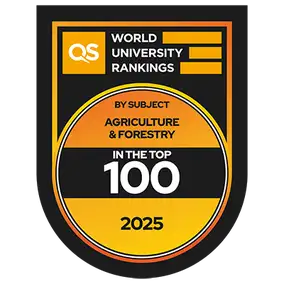
QS Ranking - Agriculture and Forestry
Massey is world-ranked and New Zealand’s No 1 university in agriculture according to QS (Quacquarelli Symonds) rankings.

ShanghaiRanking - agricultural science
Massey University is ranked No.1 in New Zealand for agricultural science by ShanghaiRanking's Global Ranking of Academic Subjects.
Related content